Application
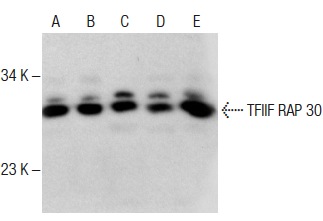
Western blot analysis of TFIIF RAP 30 expression in K-562 (A), Jurkat (B), A-431 (C), HeLa (D) and U-937 (E) nuclear extracts.| Product Name | TFIIF RAP 30 Antibody (H-148) |
|---|---|
| Antibody Type | Primary Antibodies |
| Antigen Alias | epitope corresponding to amino acids 102-249 mapping near the C-terminus of TFIIF RAP 30 of human origin |
| Modification Notes | In eukaryotic systems, initiation of transcription from protein-coding genes is a complex process requiring RNA polymerase II and broad families of auxiliary transcription factors. Such factors can be divided into two major functional classes: the basal factors that are required for transcription of all Pol II genes, including TFIIA, TFIIB, TFIID, TFIIE, TFIIF and TFIIH; and sequence-specific factors that regulate gene expression. The basal transcription factors and Pol II form a specific multiprotein complex near the transcription start site by interacting with core promotor elements such as the TATA box generally located 25-30 base pairs upstream of the transcription start site. TFIIF, a heteromer composed of a small (RAP 30) and a large (RAP 74) subunit, is required for RNA polymerase II to assemble into a preinitiation complex formed by promotor DNA and the general factors TFIID, IIA and IIB. In addition, TFIIF stimulates transcription elongation by RNA polymerase II. |
| Clonality | Polyclonal |
|---|---|
| Isotype | IgG |
| Host Species | Rabbit |
| Tested Applications | WBIPIFELISA |
| recommended for detection of TFIIF RAP 30 of mouse, rat and human origin by WB, IP, IF and ELISA also reactive with additional species, including equine, canine, bovine, porcine and avian: |
|
| Species Reactivity | HumanMouseRat |
| Concentration | 1mg/ml |
| Purification | Affinity purified |
| Alternative Names | epitope corresponding to amino acids 102-249 mapping near the C-terminus of TFIIF RAP 30 of human origin |
|---|---|
| Tissue Specificity | epitope corresponding to amino acids 102-249 mapping near the C-terminus of TFIIF RAP 30 of human origin |
| Entrez Gene | 2963 |
|---|
Application
Western blot analysis of TFIIF RAP 30 expression in K-562 (A), Jurkat (B), A-431 (C), HeLa (D) and U-937 (E) nuclear extracts.| Application Notes | recommended for detection of TFIIF RAP 30 of mouse, rat and human origin by WB, IP, IF and ELISA also reactive with additional species, including equine, canine, bovine, porcine and avian: |
|---|
| Form | Liquid |
|---|---|
| Storage Instructions | For short-term storage, store at 4° C. For long-term storage, aliquot and store at -20ºC or below. Avoid multiple freeze-thaw cycles. |
| Storage Buffer | phosphate buffered saline , pH 7.4, 150mM NaCl, 0.02% sodium azide and 50% glycerol. |


