Application
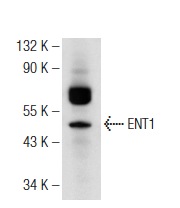
Western blot analysis of ENT1 expression in mouse heart tissue extract.| Product Name | ENT1 Antibody (M-130) |
|---|---|
| Antibody Type | Primary Antibodies |
| Antigen Alias | epitope corresponding to amino acids 211-340 mapping within an internal region of ENT1 of mouse origin |
| Modification Notes | Equilibrative nucleoside transporters (ENTs) regulate many physiological processes and are widely distributed in mammals, plants, yeasts, insects, nematodes and protozoans. They enable facilitated diffusion of hydrophilic nucleosides, such as adenosine and nucleoside analogs, across cell membranes. ENTs are required for uptake of antiviral and anticancer nucleoside drugs and influence a variety of physiological processes, such as neurotransmission and platelet aggregation, by regulating the amount of adenoside available to cell surface receptors. Equilibrative nucleoside transporter 1 (ENT1), also designated solute carrier family 29 (nucleoside transporters), member 1, belongs to the SLC29A transporter family and is a mammalian ENT isoform. ENT1, along with ENT3, mediates the majority of influx and efflux of nucleosides across the plasma membrane. |
| Clonality | Polyclonal |
|---|---|
| Isotype | IgG |
| Host Species | Rabbit |
| Tested Applications | WBIPIFELISA |
| recommended for detection of ENT1 of mouse, rat and, to a lesser extent, human origin by WB, IP, IF and ELISA: |
|
| Species Reactivity | HumanMouseRat |
| Concentration | 1mg/ml |
| Purification | Affinity purified |
| Alternative Names | epitope corresponding to amino acids 211-340 mapping within an internal region of ENT1 of mouse origin |
|---|---|
| Tissue Specificity | epitope corresponding to amino acids 211-340 mapping within an internal region of ENT1 of mouse origin |
Application
Western blot analysis of ENT1 expression in mouse heart tissue extract.| Application Notes | recommended for detection of ENT1 of mouse, rat and, to a lesser extent, human origin by WB, IP, IF and ELISA: |
|---|
| Form | Liquid |
|---|---|
| Storage Instructions | For short-term storage, store at 4° C. For long-term storage, aliquot and store at -20ºC or below. Avoid multiple freeze-thaw cycles. |
| Storage Buffer | phosphate buffered saline , pH 7.4, 150mM NaCl, 0.02% sodium azide and 50% glycerol. |


