Application
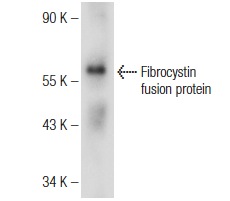
Western blot analysis of human recombinant Fibrocystin fusion protein.| Product Name | Fibrocystin Antibody (H-300) |
|---|---|
| Antibody Type | Primary Antibodies |
| Antigen Alias | epitope corresponding to amino acids 181-480 mapping within an N-terminal extracellular domain of Fibrocystin of human origin |
| Modification Notes | Fibrocystin is a type I membrane protein that undergoes regulated proteolysis. Many proteolytic cleavages occur on the ectodomain whereas at least one cleavage occurs on the cytoplasmic portion of Fibrocystin. The latter generates a C-terminal intracellular fragment that localizes to the nucleus. This proteolysis requires activation of protein kinase C (PKC) and release of intracellular calcium. Fibrocystin is expressed in the cilia of the bile duct epithelium and leads to abnormalities in the rubric of the ductal plate malformation. The intracellular C-terminus of fibrocystin interacts with calcium modulating cyclophilin ligand (CAML), a protein implicated in calcium signaling. Fibrocystin may participate in the mediation of intracellular calcium in the distal nephron in a manner similar to PKD1 and PKD2. Mutations in the PKHD1 gene, which encodes fibrocystin, result in autosomal recessive polycystic kidney disease (ARPKD), a severe form of polycystic kidney disease characterized by enlarged kidneys and congenital hepatic fibrosis. |
| Clonality | Polyclonal |
|---|---|
| Isotype | IgG |
| Host Species | Rabbit |
| Tested Applications | WBIPIFELISA |
| recommended for detection of Fibrocystin isoforms 1 and 2 of mouse, rat and human origin by WB, IP, IF and ELISA also reactive with additional species, including equine, canine and bovine: |
|
| Species Reactivity | HumanMouseRat |
| Concentration | 1mg/ml |
| Purification | Affinity purified |
| Alternative Names | epitope corresponding to amino acids 181-480 mapping within an N-terminal extracellular domain of Fibrocystin of human origin |
|---|---|
| Tissue Specificity | epitope corresponding to amino acids 181-480 mapping within an N-terminal extracellular domain of Fibrocystin of human origin |
| Entrez Gene | 5314 |
|---|
Application
Western blot analysis of human recombinant Fibrocystin fusion protein.| Application Notes | recommended for detection of Fibrocystin isoforms 1 and 2 of mouse, rat and human origin by WB, IP, IF and ELISA also reactive with additional species, including equine, canine and bovine: |
|---|
| Form | Liquid |
|---|---|
| Storage Instructions | For short-term storage, store at 4° C. For long-term storage, aliquot and store at -20ºC or below. Avoid multiple freeze-thaw cycles. |
| Storage Buffer | phosphate buffered saline , pH 7.4, 150mM NaCl, 0.02% sodium azide and 50% glycerol. |


