Application
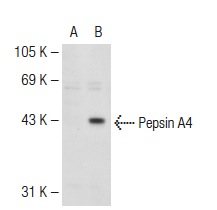
Western blot analysis of Pepsin A4 expression in non-transfected: (A) and human Pepsin A4 transfected: (B) 293 whole cell lysates.| Product Name | Pepsin A Antibody (H-44) |
|---|---|
| Antibody Type | Primary Antibodies |
| Antigen Alias | epitope corresponding to amino acids 281-324 mapping near the C-terminus of Pepsin A of human origin |
| Modification Notes | Pepsin is one of the main proteolytic enzymes secreted by the gastric mucosa. Pepsin consists of a single polypeptide chain and arises from its precursor, pepsinogen, by removal of a 41 amino acid segment from the N-terminus. Pepsinogen is synthesized in the stomach lining, and hydrochloric acid, also produced by the gastric mucosa, is necessary to convert the inactive enzyme and to maintain the optimum acidity (pH 1-3) for pepsin function. Pepsin is particularly effective in cleaving peptide bonds involving aromatic amino acids. Pepsin shows extremely broad specificity; although bonds involving phenylalanine and leucine are preferred, many others are also cleaved to some extent. Pepsin A is a member of the subfamily A1 within the pepsin family and is the predominant endopeptidase in the gastric juice of vertebrates. Pepsin A is inhibited by ovUS-1, a uterine serpin. |
| Clonality | Polyclonal |
|---|---|
| Isotype | IgG |
| Host Species | Rabbit |
| Tested Applications | WBIPIFELISA |
| recommended for detection of Pepsin A and Pepsinogen A of human origin by WB, IP, IF and ELISA also reactive with additional species, including porcine: |
|
| Species Reactivity | HumanMouseRat |
| Concentration | 1mg/ml |
| Purification | Affinity purified |
| Alternative Names | epitope corresponding to amino acids 281-324 mapping near the C-terminus of Pepsin A of human origin |
|---|---|
| Tissue Specificity | epitope corresponding to amino acids 281-324 mapping near the C-terminus of Pepsin A of human origin |
| Entrez Gene | 5222 |
|---|
Application
Western blot analysis of Pepsin A4 expression in non-transfected: (A) and human Pepsin A4 transfected: (B) 293 whole cell lysates.| Application Notes | recommended for detection of Pepsin A and Pepsinogen A of human origin by WB, IP, IF and ELISA also reactive with additional species, including porcine: |
|---|
| Form | Liquid |
|---|---|
| Storage Instructions | For short-term storage, store at 4° C. For long-term storage, aliquot and store at -20ºC or below. Avoid multiple freeze-thaw cycles. |
| Storage Buffer | phosphate buffered saline , pH 7.4, 150mM NaCl, 0.02% sodium azide and 50% glycerol. |


