Application
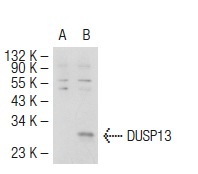
Western blot analysis of DUSP13 expression in non-transfected: (A) and human DUSP13 transfected: (B) 293T whole cell lysates.| Product Name | DUSP13 Antibody (H-138) |
|---|---|
| Antibody Type | Primary Antibodies |
| Antigen Alias | epitope corresponding to amino acids 1-138 mapping at the N-terminus of DUSP13 of human origin |
| Modification Notes | Mitogen-activated protein (MAP) kinases are a large class of proteins involved in signal transduction pathways, which are activated by a range of stimuli and mediate a number of physiological and pathological changes in the cell. Dual specificity phosphatases (DUSPs) are a subclass of the protein tyrosine phosphatase (PTP) gene superfamily, which are selective for dephosphorylating critical phosphothreonine and phosphotyrosine residues within MAP kinases. DUSP gene expression is induced by a host of growth factors and/or cellular stresses, thereby negatively regulating MAP kinase superfamily members including MAPK/ERK, SAPK/JNK and p38. DUSP13, also designated TMDP or SKRP4, is abundantly expressed in testis with lower expression in skeletal muscle. DUSP13 is thought to be involved in the regulation of meiosis and/or differentiation of testicular germ cells during spermatogenesis. |
| Clonality | Polyclonal |
|---|---|
| Isotype | IgG |
| Host Species | Rabbit |
| Tested Applications | WBIPIFELISA |
| recommended for detection of DUSP13 of mouse, rat and human origin by WB, IP, IF and ELISA also reactive with additional species, including canine, bovine and porcine: |
|
| Species Reactivity | HumanMouseRat |
| Concentration | 1mg/ml |
| Purification | Affinity purified |
| Alternative Names | epitope corresponding to amino acids 1-138 mapping at the N-terminus of DUSP13 of human origin |
|---|---|
| Tissue Specificity | epitope corresponding to amino acids 1-138 mapping at the N-terminus of DUSP13 of human origin |
| Entrez Gene | 51207 |
|---|
Application
Western blot analysis of DUSP13 expression in non-transfected: (A) and human DUSP13 transfected: (B) 293T whole cell lysates.| Application Notes | recommended for detection of DUSP13 of mouse, rat and human origin by WB, IP, IF and ELISA also reactive with additional species, including canine, bovine and porcine: |
|---|
| Form | Liquid |
|---|---|
| Storage Instructions | For short-term storage, store at 4° C. For long-term storage, aliquot and store at -20ºC or below. Avoid multiple freeze-thaw cycles. |
| Storage Buffer | phosphate buffered saline , pH 7.4, 150mM NaCl, 0.02% sodium azide and 50% glycerol. |


