Application
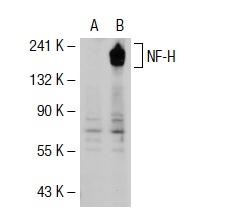
Western blot analysis of NF-H expression in non-transfected: (A) and human NF-H transfected: (B) 293T whole cell lysates.| Product Name | NF-H Antibody (H-100) |
|---|---|
| Antibody Type | Primary Antibodies |
| Antigen Alias | epitope corresponding to amino acids 1-100 mapping at the N-terminus of NF-H of human origin |
| Modification Notes | Neurofilament-H (NF-H), for neurofilament heavy polypeptide, a member of the intermediate filament family, is a major component of neuronal cytoskeletons. Neurofilaments are dynamic structures; they contain phosphorylation sites for a large number of protein kinases, including protein kinase A, protein kinase C, cyclin-dependent kinase 5, extracellular signal regulated kinase, glycogen synthase kinase-3, and stress-activated protein kinase gamma. In addition to their role in the control of axon caliber, neurofilaments may affect other cytoskeletal elements, such as microtubules and Actin filaments. Changes in neurofilament phosphorylation or metabolism are frequently observed in neurodegenerative diseases, including amyotrophic lateral sclerosis (ALS), Parkinson's disease and Alzheimer's disease. |
| Clonality | Polyclonal |
|---|---|
| Isotype | IgG |
| Host Species | Rabbit |
| Tested Applications | WBIPIFELISA |
| recommended for detection of NF-H of mouse, rat and human origin by WB, IP, IF and ELISA also reactive with additional species, including canine, bovine and porcine: |
|
| Species Reactivity | HumanMouseRat |
| Concentration | 1mg/ml |
| Purification | Affinity purified |
| Alternative Names | epitope corresponding to amino acids 1-100 mapping at the N-terminus of NF-H of human origin |
|---|---|
| Tissue Specificity | epitope corresponding to amino acids 1-100 mapping at the N-terminus of NF-H of human origin |
| Entrez Gene | 4744 |
|---|
Application
Western blot analysis of NF-H expression in non-transfected: (A) and human NF-H transfected: (B) 293T whole cell lysates.| Application Notes | recommended for detection of NF-H of mouse, rat and human origin by WB, IP, IF and ELISA also reactive with additional species, including canine, bovine and porcine: |
|---|
| Form | Liquid |
|---|---|
| Storage Instructions | For short-term storage, store at 4° C. For long-term storage, aliquot and store at -20ºC or below. Avoid multiple freeze-thaw cycles. |
| Storage Buffer | phosphate buffered saline , pH 7.4, 150mM NaCl, 0.02% sodium azide and 50% glycerol. |


