Application
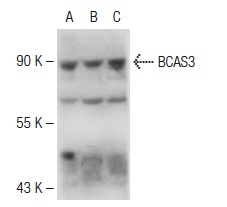
Western blot analysis of BCAS3 expression in MCF7 (A), HeLa (B) and K-562 (C) whole cell lysates.| Product Name | BCAS3 Antibody (H-300) |
|---|---|
| Antibody Type | Primary Antibodies |
| Antigen Alias | epitope corresponding to amino acids 1-300 mapping at the N-terminus of BCAS3 of human origin |
| Modification Notes | BCAS3 (breast carcinoma amplified sequence 3), also designated MAAB or GAOB1, is a 913 amino acid protein that is believed to be involved in breast cancer progression. The gene is regulated by ERå (estrogen receptor alpha) and expressed in multiple tissues, including malignant human brain lesions. It is overexpressed and amplified in breast cancer cell lines. BCAS3 contains three WD40 repeat regions, a bromodomain, a rare zinc-finger motif, four probable DNA-binding domains, and two kinase-inducible phosphorylation domains. Five variants are produced due to alternative splicing. BCAS3 interacts with histone H3 and PCAF, which is indicative of histone acetyltransferase activity. BCAS3 also exhibits ERå transactiviation activity by acting as a coactivator with PELP1 or MTA1. The amplification and translocation between the BCAS3 gene and the BCAS4 gene results in a fusion transcript is overexpressed in MCF-7 cells. |
| Clonality | Polyclonal |
|---|---|
| Isotype | IgG |
| Host Species | Rabbit |
| Tested Applications | WBIPIFELISA |
| recommended for detection of BCAS3 of mouse, rat and human origin by WB, IP, IF and ELISA also reactive with additional species, including equine, canine, bovine and porcine: |
|
| Species Reactivity | HumanMouseRat |
| Concentration | 1mg/ml |
| Purification | Affinity purified |
| Alternative Names | epitope corresponding to amino acids 1-300 mapping at the N-terminus of BCAS3 of human origin |
|---|---|
| Tissue Specificity | epitope corresponding to amino acids 1-300 mapping at the N-terminus of BCAS3 of human origin |
| Entrez Gene | 54828 |
|---|
Application
Western blot analysis of BCAS3 expression in MCF7 (A), HeLa (B) and K-562 (C) whole cell lysates.| Application Notes | recommended for detection of BCAS3 of mouse, rat and human origin by WB, IP, IF and ELISA also reactive with additional species, including equine, canine, bovine and porcine: |
|---|
| Form | Liquid |
|---|---|
| Storage Instructions | For short-term storage, store at 4° C. For long-term storage, aliquot and store at -20ºC or below. Avoid multiple freeze-thaw cycles. |
| Storage Buffer | phosphate buffered saline , pH 7.4, 150mM NaCl, 0.02% sodium azide and 50% glycerol. |


