Application
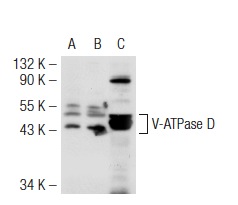
Western blot analysis of V-ATPase D expression in non-transfected: (A) and mouse V-ATPase D transfected: (B) 293T whole cell lysates and mouse brain tissue extract (C).| Product Name | V-ATPase D Antibody (FL-247) |
|---|---|
| Antibody Type | Primary Antibodies |
| Antigen Alias | epitope corresponding to amino acids 1-243 representing full length V-ATPase D of human origin |
| Modification Notes | Vacuolar-type H+-ATPase (V-ATPase) is a multi-subunit enzyme responsible for acidification of eukaryotic intracellular organelles. V-ATPases pump protons against an electrochemical gradient, while F-ATPases reverse the process, thereby synthesizing ATP. A peripheral V1 domain, which is responsible for ATP hydrolysis, and an integral V0 domain, which is responsible for proton translocation, compose V-ATPase. Nine subunits (A-H) make up the V1 domain and five subunits (a, d, c, c' and c’’) make up the V0 domain. Like F-ATPase, V-ATPase most likely operates through a rotary mechanism. V-ATPase C is an auxiliary subunit with ubiquitous expression. |
| Clonality | Polyclonal |
|---|---|
| Isotype | IgG |
| Host Species | Rabbit |
| Tested Applications | WBIPIFELISA |
| recommended for detection of V-ATPase D of mouse, rat and human origin by WB, IP, IF and ELISA also reactive with additional species, including equine, canine, bovine, porcine and avian: |
|
| Species Reactivity | HumanMouseRat |
| Concentration | 1mg/ml |
| Purification | Affinity purified |
| Alternative Names | epitope corresponding to amino acids 1-243 representing full length V-ATPase D of human origin |
|---|---|
| Tissue Specificity | epitope corresponding to amino acids 1-243 representing full length V-ATPase D of human origin |
| Entrez Gene | 51382 |
|---|
Application
Western blot analysis of V-ATPase D expression in non-transfected: (A) and mouse V-ATPase D transfected: (B) 293T whole cell lysates and mouse brain tissue extract (C).| Application Notes | recommended for detection of V-ATPase D of mouse, rat and human origin by WB, IP, IF and ELISA also reactive with additional species, including equine, canine, bovine, porcine and avian: |
|---|
| Form | Liquid |
|---|---|
| Storage Instructions | For short-term storage, store at 4° C. For long-term storage, aliquot and store at -20ºC or below. Avoid multiple freeze-thaw cycles. |
| Storage Buffer | phosphate buffered saline , pH 7.4, 150mM NaCl, 0.02% sodium azide and 50% glycerol. |


