Application
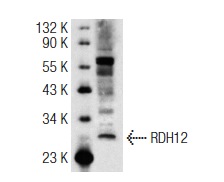
Western blot analysis of RDH12 expression in human platelet whole cell lysate.Application
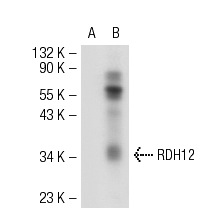
Western blot analysis of RDH12 expression in non-transfected: (A) and human RDH12 transfected: (B) 293 whole cell lysates.| Product Name | RDH12 Antibody (H-40) |
|---|---|
| Antibody Type | Primary Antibodies |
| Antigen Alias | epitope corresponding to amino acids 277-316 mapping at the C-terminus of RDH12 of human origin |
| Modification Notes | Retinol dehydrogenase 12 (RDH12), also known as all-trans and 9-cis retinol dehydrogenase, LCA3, LCA13 or SDR7C2, is a 316 amino acid protein belonging to the short-chain dehydrogenases/reductases (SDR) family. Widely expressed, mostly in eye, kidney, brain, skeletal muscle and stomach, RDH12 exhibits an oxidoreductive catalytic activity towards retinoids. RDH12 is an efficient NADPH-dependent retinal reductase and displays high activity toward 9-cis and all-trans-retinol. RDH12 is involved in the metabolism of short-chain aldehydes and may be a key enzyme in the formation of 11-cis-retinal from 11-cis-retinol during regeneration of the cone visual pigments. Leber congenital amaurosis (LCA) type 3, an inherited autosomal recessive retinal disease, has been associated with defects of RDH12. LCA represents the most common genetic cause of congenital visual impairment in infants and children. |
| Clonality | Polyclonal |
|---|---|
| Isotype | IgG |
| Host Species | Rabbit |
| Tested Applications | WBIPIFELISA |
| recommended for detection of RDH12 of mouse, rat and human origin by WB, IP, IF and ELISA also reactive with additional species, including equine, canine, bovine and porcine: |
|
| Species Reactivity | HumanMouseRat |
| Concentration | 1mg/ml |
| Purification | Affinity purified |
| Alternative Names | epitope corresponding to amino acids 277-316 mapping at the C-terminus of RDH12 of human origin |
|---|---|
| Tissue Specificity | epitope corresponding to amino acids 277-316 mapping at the C-terminus of RDH12 of human origin |
| Entrez Gene | 145226 |
|---|
Application
Western blot analysis of RDH12 expression in human platelet whole cell lysate.
Application
Western blot analysis of RDH12 expression in non-transfected: (A) and human RDH12 transfected: (B) 293 whole cell lysates.| Application Notes | recommended for detection of RDH12 of mouse, rat and human origin by WB, IP, IF and ELISA also reactive with additional species, including equine, canine, bovine and porcine: |
|---|
| Form | Liquid |
|---|---|
| Storage Instructions | For short-term storage, store at 4° C. For long-term storage, aliquot and store at -20ºC or below. Avoid multiple freeze-thaw cycles. |
| Storage Buffer | phosphate buffered saline , pH 7.4, 150mM NaCl, 0.02% sodium azide and 50% glycerol. |


