Application
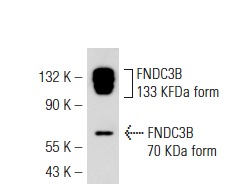
Western blot analysis of FNDC3B expression in 3T3-L1 whole cell lysate.| Product Name | FNDC3B Antibody (N-12) |
|---|---|
| Antibody Type | Primary Antibodies |
| Antigen Alias | epitope mapping at the N-terminus of FNDC3B of human origin |
| Modification Notes | Adipogenesis, the process of transforming pre-adipocytes into mature fat cells, is of particular interest due to the role adipocytes play in obesity and type II diabetes. Adipocytes have been shown to affect a variety of functions, including hemostasis, angiogenesis and energy balance, by secreting hormones and bioactive peptides. The FNDC3B protein, also designated FAD104 (factor for adipocyte differentiation 104) or HCV NS5A-binding protein 37, is expressed during early adipogenesis. Belonging to the FNDC3 family of proteins, FNDC3B is a 1,204 amino acid protein that contains nine fibronectin type-III domains. FNDC3B-deficient mice die within one day of birth, suggesting that FNDC3B is crucial for postpartum survival. Mouse embryonic fibroblasts (MEFs) with loss of FNDC3B function displayed a reduction in stress fiber formation, indicating a role for FNDC3B in cell proliferation, adhesion, spreading and migration. |
| Clonality | Polyclonal |
|---|---|
| Isotype | IgG |
| Host Species | Rabbit |
| Tested Applications | WBIPIFELISA |
| recommended for detection of FNDC3B of mouse, rat and human origin by WB, IP, IF and ELISA non cross-reactive with other FNDC family members: |
|
| Species Reactivity | HumanMouseRat |
| Concentration | 1mg/ml |
| Purification | Affinity purified |
| Alternative Names | epitope mapping at the N-terminus of FNDC3B of human origin |
|---|---|
| Tissue Specificity | epitope mapping at the N-terminus of FNDC3B of human origin |
| Entrez Gene | 64778 |
|---|
Application
Western blot analysis of FNDC3B expression in 3T3-L1 whole cell lysate.| Application Notes | recommended for detection of FNDC3B of mouse, rat and human origin by WB, IP, IF and ELISA non cross-reactive with other FNDC family members: |
|---|
| Form | Liquid |
|---|---|
| Storage Instructions | For short-term storage, store at 4° C. For long-term storage, aliquot and store at -20ºC or below. Avoid multiple freeze-thaw cycles. |
| Storage Buffer | phosphate buffered saline , pH 7.4, 150mM NaCl, 0.02% sodium azide and 50% glycerol. |


