Application
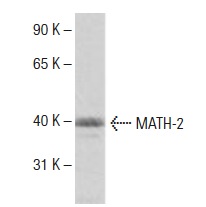
Western blot analysis of human MATH-2 transfected 293T whole cell lysate.| Product Name | MATH-2 Antibody (Z-23) |
|---|---|
| Antibody Type | Primary Antibodies |
| Antigen Alias | recommended for detection of MATH-2 of mouse, rat and human origin by WB, IP and ELISA; also reactive with additional species, including canine |
| Modification Notes | The Drosophila atonal gene produces a protein with basic helix loop helix (bHLH) domains that plays an essential role in the development of the Drosophila nervous system. Mammalian atonal homolog 2 (MATH-2) is a helix-loop-helix (HLH) transcription factor that is structurally homologous to the product of Drosophila atonal gene. MATH-2 is a 337 amino acid protein with an atonal-related basic HLH domain. In mice, expression of MATH-2 takes place by embryonic day 11.5 and initially localizes to the wall of brain vesicles and in the spinal cord. It is expressed in the cortical plate and the mantle layer in the developing central nervous system, and is limited to the nervous system in adults. Adult mouse cerebrums produce a high level of MATH-2 RNA with lower levels in other neuronal tissues. Research studies suggest that MATH-2 may function as a trans-acting factor involved in the development and maintenance of the mammalian nervous system. |
| Clonality | Polyclonal |
|---|---|
| Isotype | IgG |
| Host Species | Rabbit |
| Tested Applications | WBIPELISA |
| WB:1:500~1:2000 IP:1:100~1:500 Notes:Optimal dilutions/concentrations should be determined by the researcher. |
|
| Species Reactivity | HumanMouseRat |
| Concentration | 1mg/ml |
| Purification | Affinity purified |
| Alternative Names | recommended for detection of MATH-2 of mouse rat and human origin by WB IP and ELISA also reactive with additional species including canine |
|---|---|
| Tissue Specificity | recommended for detection of MATH-2 of mouse, rat and human origin by WB, IP and ELISA; also reactive with additional species, including canine |
| Entrez Gene | 63974 |
|---|
Application
Western blot analysis of human MATH-2 transfected 293T whole cell lysate.| Application Notes | WB:1:500~1:2000 IP:1:100~1:500 Notes:Optimal dilutions/concentrations should be determined by the researcher. |
|---|
| Form | Liquid |
|---|---|
| Storage Instructions | For short-term storage, store at 4° C. For long-term storage, aliquot and store at -20ºC or below. Avoid multiple freeze-thaw cycles. |
| Storage Buffer | phosphate buffered saline , pH 7.4, 150mM NaCl, 0.02% sodium azide and 50% glycerol. |


