Application
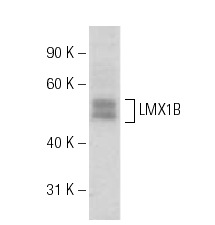
Western blot analysis of LMX1B expression in human fetal muscle tissue extract.| Product Name | LMX1B Antibody (T-25) |
|---|---|
| Antibody Type | Primary Antibodies |
| Antigen Alias | recommended for detection of LMX1B of mouse, rat, human and zebrafish origin by WB, IP and ELISA; also reactive with additional species, including canine |
| Modification Notes | Nail-patella syndrome (NPS) is an autosomal dominant disorder characterized by dyplasia of finger nails, skeletal anomalies and, frequently, renal disease. NPS is caused by putative loss-of-function mutations in the transcription factor LMX1B. LMX1B belongs to the LIM-homeodomain family, members of which are known to be important for pattern formation during development. Twenty-two novel mutations may occur in the gene encoding LMX1B and the type and distribution of the mutations support the hypothesis that NPS is the result of haploinsufficiency for LMX1B. LMX1B is also necessary for normal development of the eye and in regulating dopaminergic neurogenesis and may be involved in developmental glaucoma and the aetiology of idiopathic Parkinson’s disease. Specifically, LMX1B along with LIM1 control the initial trajectory of motor axons in the developing mammalian limb. In addition, LMX1B directly regulates the coordinated expression of alpha 3(IV) and alpha 4(IV) collagen required for normal glomerular basement membrane (GBM) morphogenesis, and the dysregulation of LMX1B in GBM contributes to the renal pathology and nephrosis in NPS. |
| Clonality | Polyclonal |
|---|---|
| Isotype | IgG |
| Host Species | Rabbit |
| Tested Applications | WBIPELISA |
| WB:1:500~1:2000 IP:1:100~1:500 Notes:Optimal dilutions/concentrations should be determined by the researcher. |
|
| Species Reactivity | HumanMouseRat |
| Concentration | 1mg/ml |
| Purification | Affinity purified |
| Alternative Names | recommended for detection of LMX1B of mouse rat human and zebrafish origin by WB IP and ELISA also reactive with additional species including canine |
|---|---|
| Tissue Specificity | recommended for detection of LMX1B of mouse, rat, human and zebrafish origin by WB, IP and ELISA; also reactive with additional species, including canine |
| Entrez Gene | 4010 |
|---|
Application
Western blot analysis of LMX1B expression in human fetal muscle tissue extract.| Application Notes | WB:1:500~1:2000 IP:1:100~1:500 Notes:Optimal dilutions/concentrations should be determined by the researcher. |
|---|
| Form | Liquid |
|---|---|
| Storage Instructions | For short-term storage, store at 4° C. For long-term storage, aliquot and store at -20ºC or below. Avoid multiple freeze-thaw cycles. |
| Storage Buffer | phosphate buffered saline , pH 7.4, 150mM NaCl, 0.02% sodium azide and 50% glycerol. |


