Application
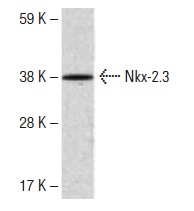
Western blot analysis of Nkx-2.3 expression in NCI-H226 whole cell lysate.| Product Name | Nkx-2.3 Antibody (O-21) |
|---|---|
| Antibody Type | Primary Antibodies |
| Antigen Alias | recommended for detection of Nkx-2.3 of mouse and rat origin by WB, IP and ELISA |
| Modification Notes | Nkx homeodomain proteins are members of a large family of vertebrate transcription factors that have a strong homology to the NK genes in Drosophila. Nkx proteins are involved in several aspects of cell type specification and maintenance of differentiated tissue functions. Nkx-2.3 contains a homeobox, a conserved NK2 domain, a C-terminal GIRAW motif and an N-terminal homology domain that is conserved among all NK2 genes. Expression of Nkx-2.3 is activated later in differentiated myocardial cells, and the protein is primarily detected in gut mesoderm, distinct regions of the brachial arches, the tongue epithelium and some domains in the developing jaws. Nkx-2.3 is necessary to function as a transcriptional activator during the earliest stages of heart formation. Overexpression of Nkx-2.3 leads to an enlarged heart due to a thickening of the myocardium caused by an increase in the overall number of myocardial cells. |
| Clonality | Polyclonal |
|---|---|
| Isotype | IgG |
| Host Species | Rabbit |
| Tested Applications | WBIPELISA |
| WB:1:500~1:2000 IP:1:100~1:500 Notes:Optimal dilutions/concentrations should be determined by the researcher. |
|
| Species Reactivity | HumanMouseRat |
| Concentration | 1mg/ml |
| Purification | Affinity purified |
| Alternative Names | recommended for detection of Nkx-2.3 of mouse and rat origin by WB IP and ELISA |
|---|---|
| Tissue Specificity | recommended for detection of Nkx-2.3 of mouse and rat origin by WB, IP and ELISA |
| Entrez Gene | 18089 |
|---|
Application
Western blot analysis of Nkx-2.3 expression in NCI-H226 whole cell lysate.| Application Notes | WB:1:500~1:2000 IP:1:100~1:500 Notes:Optimal dilutions/concentrations should be determined by the researcher. |
|---|
| Form | Liquid |
|---|---|
| Storage Instructions | For short-term storage, store at 4° C. For long-term storage, aliquot and store at -20ºC or below. Avoid multiple freeze-thaw cycles. |
| Storage Buffer | phosphate buffered saline , pH 7.4, 150mM NaCl, 0.02% sodium azide and 50% glycerol. |


