Application
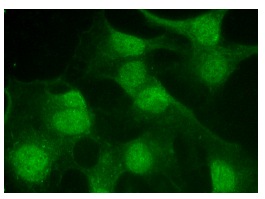
Immunofluorescence staining of methanol-fixed Hep G2 cells showing nuclear and cytoplasmic localization.Application
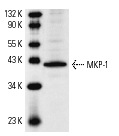
Western blot analysis of MKP-1 expression in HeLa whole cell lysate.| Product Name | MKP-1 Antibody (C-19) |
|---|---|
| Antibody Type | Primary Antibodies |
| Antigen Alias | epitope mapping near the C-terminus of MKP-1 of human origin |
| Modification Notes | A key element in the pathway involved in the transduction of signals from activated protein-tyrosine kinase transmembrane receptors has been identified as the family of mitogen-activated protein kinases (MAP kinases). The most well known of these Ser/Thr kinases are ERK 1 and ERK 2. Mitogenic stimulation of cells triggers the activation of MAP kinases through phosphorylation of both tyrosyl (Y185) and threonyl (T183) residues. Phosphorylation of the T183 and Y185 ERK regulatory site is mediated by MAP kinase (MEK), which in turn is regulated by the proto-oncogene product Raf. Two highly related phosphatases, designated MKP-1 and MKP-2, exhibit 59% sequence identity at the amino acid level and oppose the action of MEK by downregulating the kinase activity of ERK 1 and ERK 2. MAP kinase phosphatase-1 and -2 proteins function by dephosphorylating ERK 1 and ERK 2 at their T-E-Y regulatory motif. An additional phosphatase encoded by the DUSP2 gene, designated PAC-1, also functions to downregulate ERK 1 and ERK 2 kinase activity. PAC-1 is a nuclear protein whose expression is strongly induced in response to mitogen. |
| Clonality | Polyclonal |
|---|---|
| Isotype | IgG |
| Host Species | Rabbit |
| Tested Applications | WBIPIFELISA |
| recommended for detection of MKP-1 of mouse, rat and human origin by WB, IP, IF and ELISA: |
|
| Species Reactivity | HumanMouseRat |
| Concentration | 1mg/ml |
| Purification | Affinity purified |
| Alternative Names | epitope mapping near the C-terminus of MKP-1 of human origin |
|---|---|
| Tissue Specificity | epitope mapping near the C-terminus of MKP-1 of human origin |
| Entrez Gene | 1843 |
|---|
Application
Immunofluorescence staining of methanol-fixed Hep G2 cells showing nuclear and cytoplasmic localization.
Application
Western blot analysis of MKP-1 expression in HeLa whole cell lysate.| Application Notes | recommended for detection of MKP-1 of mouse, rat and human origin by WB, IP, IF and ELISA: |
|---|
| Form | Liquid |
|---|---|
| Storage Instructions | For short-term storage, store at 4° C. For long-term storage, aliquot and store at -20ºC or below. Avoid multiple freeze-thaw cycles. |
| Storage Buffer | phosphate buffered saline , pH 7.4, 150mM NaCl, 0.02% sodium azide and 50% glycerol. |


