Application
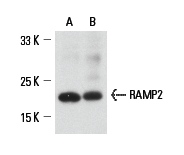
Western blot analysis of RAMP2 expression in rat (A) and mouse (B) brain tissue extracts.| Product Name | RAMP2 Antibody (H-139) |
|---|---|
| Antibody Type | Primary Antibodies |
| Antigen Alias | epitope corresponding to amino acids 28-166 mapping near the N-terminus of RAMP2 of human origin |
| Modification Notes | Receptor activity-modifying proteins (RAMPs) are transmembrane accessory proteins that influence the pharmacological profiles of the calcitonin receptor-like receptors (CRLR) (1). RAMPs associate with CRLR in the endoplasmic reticulum and facilitate the glycosylation and transport of CRLR to the cell surface, where the mature protein then operates as a receptor for two structurally related vasodilatory peptides, calcitonin-gene-related peptide (CGRP) or adrenomedullin (ADM) (2). RAMP-1 associating with CRLR confers a CGRP receptor, while RAMP-2 and RAMP-3 preferentially induce a responsiveness to ADM (3,4). RAMP proteins, including RAMP-1, RAMP-2 and RAMP-3, are structurally similar as they are type I receptors, which have a single extracellular N-terminus and a cytoplasmic C-terminus, and they share approximately 55% sequence similarity (5). RAMP-1 expression is highest in the uterus, brain and gastrointestinal tract, whereas RAMP-2 and RAMP-3 are highest in lung, breast and fetal tissues (6,7) |
| Clonality | Polyclonal |
|---|---|
| Isotype | IgG |
| Host Species | Rabbit |
| Tested Applications | WBIPIFELISA |
| recommended for detection of RAMP2 of mouse, rat and human origin by WB, IP, IF and ELISA: |
|
| Species Reactivity | HumanMouseRat |
| Concentration | 1mg/ml |
| Purification | Affinity purified |
| Alternative Names | epitope corresponding to amino acids 28-166 mapping near the N-terminus of RAMP2 of human origin |
|---|---|
| Tissue Specificity | epitope corresponding to amino acids 28-166 mapping near the N-terminus of RAMP2 of human origin |
| Entrez Gene | 10266 |
|---|
Application
Western blot analysis of RAMP2 expression in rat (A) and mouse (B) brain tissue extracts.| Application Notes | recommended for detection of RAMP2 of mouse, rat and human origin by WB, IP, IF and ELISA: |
|---|
| Form | Liquid |
|---|---|
| Storage Instructions | For short-term storage, store at 4° C. For long-term storage, aliquot and store at -20ºC or below. Avoid multiple freeze-thaw cycles. |
| Storage Buffer | phosphate buffered saline , pH 7.4, 150mM NaCl, 0.02% sodium azide and 50% glycerol. |


