Application
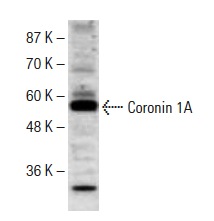
Western blot analysis of Coronin 1A expression in Jurkat whole cell lysate.| Product Name | Coronin 1A Antibody (E-21) |
|---|---|
| Antibody Type | Primary Antibodies |
| Antigen Alias | recommended for detection of Coronin 1A of human origin by WB, IP and ELISA; also reactive with additional species, including canine |
| Modification Notes | Coronins are a family of WD repeat-containing, actin-binding proteins that localize to submembraneous areas and regulate cell motility and cytoskeletal rearrangement. Coronin 1A (CORO1A, CLIPINA, CLABP, TACO, p57) can form coiled coil-mediated homotrimeric complexes that influence early phagosome formation. PKC-dependent phosphorylation of Coronin 1B (CORO1B) at Serine 2 regulates leading edge dynamics and cell motility in fibroblasts through interactions with Arp2/3 complex. Coronin 1C (CORO1C, Coronin 3, HCRNN4) is abundant in differentiating Neuro-2a cells, PC-12 cells and primary oligodendrocytes, where it is thought to influence neuron morphogenesis and migration. Coronin 2A (CORO2A, CLIPINB, IR10, WDR2) is a component of the approximately 1.5-2 megadalton N-CoR (nuclear receptor corepressor) complex of 10-12 proteins, which recruits HDACs to generate repressive chromatin. Coronin 7 (CORO7, CRN7) localizes to the Golgi membrane and influences the organization of intracellular membrane compartments and vesicular trafficking. Coronin 2B (CORO2B, CLIPINC) and Coronin 6 (CORO6) are similar to other members of this family, since they possess a conserved basic N-terminal motif and 3-10 WD repeats clustered in one to two core domains. |
| Clonality | Polyclonal |
|---|---|
| Isotype | IgG |
| Host Species | Rabbit |
| Tested Applications | WBIPELISA |
| WB:1:500~1:2000 IP:1:100~1:500 Notes:Optimal dilutions/concentrations should be determined by the researcher. |
|
| Species Reactivity | HumanMouseRat |
| Concentration | 1mg/ml |
| Purification | Affinity purified |
| Alternative Names | recommended for detection of Coronin 1A of human origin by WB IP and ELISA also reactive with additional species including canine |
|---|---|
| Tissue Specificity | recommended for detection of Coronin 1A of human origin by WB, IP and ELISA; also reactive with additional species, including canine |
| Entrez Gene | 11151 |
|---|
Application
Western blot analysis of Coronin 1A expression in Jurkat whole cell lysate.| Application Notes | WB:1:500~1:2000 IP:1:100~1:500 Notes:Optimal dilutions/concentrations should be determined by the researcher. |
|---|
| Form | Liquid |
|---|---|
| Storage Instructions | For short-term storage, store at 4° C. For long-term storage, aliquot and store at -20ºC or below. Avoid multiple freeze-thaw cycles. |
| Storage Buffer | phosphate buffered saline , pH 7.4, 150mM NaCl, 0.02% sodium azide and 50% glycerol. |


