Application
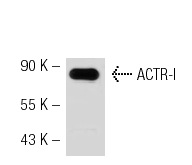
Western blot analysis of ACTR-I expression in SK-N-SH whole cell lysate.| Product Name | ACTR-I Antibody (H-170) |
|---|---|
| Antibody Type | Primary Antibodies |
| Antigen Alias | epitope corresponding to amino acids 21-120 mapping near the N-terminus of ACTR-IA of human origin |
| Modification Notes | Members of the transforming growth factor b superfamily bind to a pair of transmembrane proteins, known as receptor types I and II, which contain serine/threonine kinases and associate to form a signaling complex (1). Activin has been shown to bind a heteromeric noncovalent complex, which consists of a type I receptor, ACTR-IA (also designated ACVRI and ALK-2) or ACTR-IB (also designated ALK-4 and SKR2), and a type II receptor, ACTR-IIA (also designated ACVR2A) or ACTR-IIB (also designated ACVR2B) (1–6). Both receptor types are highly expressed in brain (5). The activin receptor family members are thought to mediate distinct effects on gene expression, cell differentiation, and morpho- genesis in a dose dependent fashion (5,6). |
| Clonality | Polyclonal |
|---|---|
| Isotype | IgG |
| Host Species | Rabbit |
| Tested Applications | WBIPIFELISA |
| recommended for detection of ACTR-IA of mouse, rat and human origin by WB, IP, IF and ELISA also reactive with additional species, including equine, canine, bovine and porcine: |
|
| Species Reactivity | HumanMouseRat |
| Concentration | 1mg/ml |
| Purification | Affinity purified |
| Alternative Names | epitope corresponding to amino acids 21-120 mapping near the N-terminus of ACTR-IA of human origin |
|---|---|
| Tissue Specificity | epitope corresponding to amino acids 21-120 mapping near the N-terminus of ACTR-IA of human origin |
| Entrez Gene | 90 |
|---|
Application
Western blot analysis of ACTR-I expression in SK-N-SH whole cell lysate.| Application Notes | recommended for detection of ACTR-IA of mouse, rat and human origin by WB, IP, IF and ELISA also reactive with additional species, including equine, canine, bovine and porcine: |
|---|
| Form | Liquid |
|---|---|
| Storage Instructions | For short-term storage, store at 4° C. For long-term storage, aliquot and store at -20ºC or below. Avoid multiple freeze-thaw cycles. |
| Storage Buffer | phosphate buffered saline , pH 7.4, 150mM NaCl, 0.02% sodium azide and 50% glycerol. |


