Application
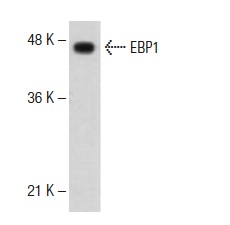
Western blot analysis of EBP1 expression in Hep G2 whole cell lysate.Application
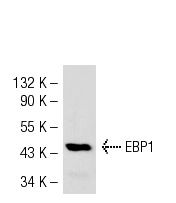
Western blot analysis of EBP1 expression in HeLa whole cell lysate.| Product Name | EBP1 Antibody (T-21) |
|---|---|
| Antibody Type | Primary Antibodies |
| Antigen Alias | recommended for detection of EBP1 of mouse, rat, human and zebrafish origin by WB, IP and ELISA; also reactive with additional species, including canine |
| Modification Notes | EBP1 (ErbB3-binding protein 1), also known as PA2G4 (proliferation-associated 2G4), p38-2G4 or HG4-1, is a member of the peptidase M24C family and functions as an RNA-binding protein involved in cellular proliferation and differentiation processes. It is expressed in a variety of cell lines, including a wide range of tumor cell lines, and localizes to the cytoplasm. Upon treatment with Neuregulin-1 (heregulin), EBP1 translocates to the nucleus. EBP1 is a component of pre-ribosomal ribonucleoprotein complexes, participating in ribosome assembly and regulating the later steps of rRNA processing. In addition, EBP1 interacts with ErbB-3 and may function as a modulator of the ErbB-3-mediated signal transduction pathway by regulating the effects of Neuregulin-1 (heregulin). EBP1 also associates with histone deacetylases (HDACs), functioning as a transcriptional co-repressor of cell cycle regulatory genes. |
| Clonality | Polyclonal |
|---|---|
| Isotype | IgG |
| Host Species | Rabbit |
| Tested Applications | WBIPELISA |
| WB:1:500~1:2000 IP:1:100~1:500 Notes:Optimal dilutions/concentrations should be determined by the researcher. |
|
| Species Reactivity | HumanMouseRat |
| Concentration | 1mg/ml |
| Purification | Affinity purified |
| Alternative Names | recommended for detection of EBP1 of mouse rat human and zebrafish origin by WB IP and ELISA also reactive with additional species including canine |
|---|---|
| Tissue Specificity | recommended for detection of EBP1 of mouse, rat, human and zebrafish origin by WB, IP and ELISA; also reactive with additional species, including canine |
| Entrez Gene | 5036 |
|---|
Application
Western blot analysis of EBP1 expression in Hep G2 whole cell lysate.
Application
Western blot analysis of EBP1 expression in HeLa whole cell lysate.| Application Notes | WB:1:500~1:2000 IP:1:100~1:500 Notes:Optimal dilutions/concentrations should be determined by the researcher. |
|---|
| Form | Liquid |
|---|---|
| Storage Instructions | For short-term storage, store at 4° C. For long-term storage, aliquot and store at -20ºC or below. Avoid multiple freeze-thaw cycles. |
| Storage Buffer | phosphate buffered saline , pH 7.4, 150mM NaCl, 0.02% sodium azide and 50% glycerol. |


