Application
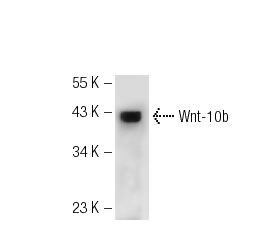
Western blot analysis of Wnt-10b expression in rat heart tissue extract.| Product Name | Wnt-10b Antibody (H-70) |
|---|---|
| Antibody Type | Primary Antibodies |
| Antigen Alias | epitope corresponding to amino acids 121-190 mapping to an internal region of Wnt-10b of human origin |
| Modification Notes | Products of the highly conserved Wnt gene family play key roles in regulating cellular growth and differentiation (1,2). The prototype member of the Wnt gene family, Wnt-1, is a cysteine-rich secreted glycoprotein that asociates with cell membranes and likely functions as a key regulator of cellular adhesion (3). b-catenin, a cadherin-binding cellular adhesion protein that also binds to the tumor suppressor gene APC, has been identified as a downstream target of a signal transduction pathway mediated by Wnt-1 (4,5). Wnt-1 is essential for normal development of the embryonic nervous system and its expression is normally limited to the embryonic neural tube and adult spermatids (6). Wnt family members have been shown to interact with Sonic hedgehog (Shh) in vivo to induce myogenesis in somitic tissue (7). Wnt-10b has been implicated along with FGF-3 in the development of mouse mammary tumor virus induced mouse mammary carcinomas (8). |
| Clonality | Polyclonal |
|---|---|
| Isotype | IgG |
| Host Species | Rabbit |
| Tested Applications | WBIPIFELISA |
| recommended for detection of Wnt-10b of mouse, rat and human origin by WB, IP, IF and ELISA also reactive with additional species, including porcine: |
|
| Species Reactivity | HumanMouseRat |
| Concentration | 1mg/ml |
| Purification | Affinity purified |
| Alternative Names | epitope corresponding to amino acids 121-190 mapping to an internal region of Wnt-10b of human origin |
|---|---|
| Tissue Specificity | epitope corresponding to amino acids 121-190 mapping to an internal region of Wnt-10b of human origin |
| Entrez Gene | 7480 |
|---|
Application
Western blot analysis of Wnt-10b expression in rat heart tissue extract.| Application Notes | recommended for detection of Wnt-10b of mouse, rat and human origin by WB, IP, IF and ELISA also reactive with additional species, including porcine: |
|---|
| Form | Liquid |
|---|---|
| Storage Instructions | For short-term storage, store at 4° C. For long-term storage, aliquot and store at -20ºC or below. Avoid multiple freeze-thaw cycles. |
| Storage Buffer | phosphate buffered saline , pH 7.4, 150mM NaCl, 0.02% sodium azide and 50% glycerol. |


