Application
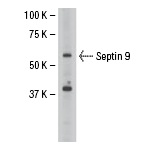
Western blot analysis of Septin 9 expression in Jurkat whole cell lysate.Application
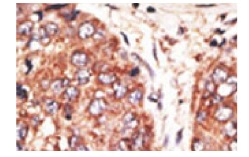
Immunoperoxidase staining of formalin fixed, paraffin-embedded human cancer tissue showing cytoplasmic staining.| Product Name | Septin 9 Antibody (C-25) |
|---|---|
| Antibody Type | Primary Antibodies |
| Antigen Alias | recommended for detection of Septin 9 of human origin by WB, IP, IF, IHC(P) and ELISA |
| Modification Notes | Septins are members of a conserved family of cytoskeletal GTPases, specifically belonging to the large superclass of P-loop GTPases. Septin proteins form homo- and hetero-oligomeric polymers that accumulate into higher-order filaments which may function as dynamic protein scaffolds. Septins play an important role in vesicle trafficking, apoptosis, cytoskeleton remodeling, infection, neurodegeneration, neoplasia and cytokinesis. Septin 9 is expressed in lymphoid tissues and has an elaborate genomic structure. There are 15 different isoforms of Septin 9, made possible by intermixing five alternate amino termini and three alternate carboxy termini. Changes in the levels of Septin 9 by overexpression of these individual isoforms can disturb cellular behavior and may be implicated in neoplasia. Septin 9 is commonly upregulated in ovarian tumors and may be linked to hereditary neuralgic amyotrophy (HNA). HNA is an autosomal dominant, recurrent neuropathy affecting the brachial plexus. |
| Clonality | Polyclonal |
|---|---|
| Isotype | IgG |
| Host Species | Rabbit |
| Tested Applications | WBIPIFIHCELISA |
| See 1 citations for Septin 9Antibody (C-25): |
|
| Species Reactivity | HumanMouseRat |
| Concentration | 1mg/ml |
| Purification | Affinity purified |
| Alternative Names | recommended for detection of Septin 9 of human origin by WB IP IF IHC(P) and ELISA |
|---|---|
| Tissue Specificity | recommended for detection of Septin 9 of human origin by WB, IP, IF, IHC(P) and ELISA |
| Entrez Gene | 10801 |
|---|
Application
Western blot analysis of Septin 9 expression in Jurkat whole cell lysate.
Application
Immunoperoxidase staining of formalin fixed, paraffin-embedded human cancer tissue showing cytoplasmic staining.| Application Notes | See 1 citations for Septin 9Antibody (C-25): |
|---|
| Form | Liquid |
|---|---|
| Storage Instructions | For short-term storage, store at 4° C. For long-term storage, aliquot and store at -20ºC or below. Avoid multiple freeze-thaw cycles. |
| Storage Buffer | phosphate buffered saline , pH 7.4, 150mM NaCl, 0.02% sodium azide and 50% glycerol. |


