Application
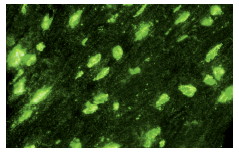
Immunofluorescence staining of normal mouse liver frozen section showing nuclear staining.Application
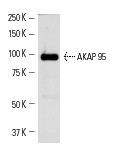
Western blot analysis of AKAP 95 expression in 3611-RF whole cell lysate.| Product Name | AKAP 95 Antibody (R-146) |
|---|---|
| Antibody Type | Primary Antibodies |
| Modification Notes | The type II cAMP-protein kinase (PKA) is a multifunctional kinase with a broad range of substrates. Specificity of PKA signaling is thought to be mediated by the compartmentalization of the kinase to specific sites within the cell. To maintain this specific localization, the R subunit (RII) of PKA interacts with specific RII-anchoring proteins. The family of RII-anchoring proteins has been designated A-kinase anchoring proteins (AKAP). AKAP 95, also known as AKAP 8, is a nuclear matrix protein predominantly expressed in liver, heart, pancreas, kidney and skeletal muscle. During mitosis, AKAP 95 is recruited to the chromosomes and plays an essential role in mitotic progression. Characteristic of its family, AKAP 95 participates in PKA signaling through an interaction with the RII regulatory subunit. In addition, AKAP 95 forms a complex with HA95 and HDAC3 and is required for the deacetylation of Histone H3 in mitosis. |
| Clonality | Polyclonal |
|---|---|
| Isotype | IgG |
| Host Species | Rabbit |
| Tested Applications | WBIPIFELISA |
| recommended for detection of AKAP 95 of mouse, rat and, to a lesser extent, human origin by WB, IP, IF and ELISA | |
| Species Reactivity | HumanMouseRat |
| Concentration | 1mg/ml |
| Purification | Affinity purified |
| Alternative Names | epitope corresponding to amino acids 542-687 mapping to an internal region of AKAP 95 of rat origin |
|---|---|
| Tissue Specificity | epitope corresponding to amino acids 542-687 mapping to an internal region of AKAP 95 of rat origin |
| Entrez Gene | 10270 |
|---|
Application
Immunofluorescence staining of normal mouse liver frozen section showing nuclear staining.
Application
Western blot analysis of AKAP 95 expression in 3611-RF whole cell lysate.| Application Notes | recommended for detection of AKAP 95 of mouse, rat and, to a lesser extent, human origin by WB, IP, IF and ELISA |
|---|
| Form | Liquid |
|---|---|
| Storage Instructions | For short-term storage, store at 4° C. For long-term storage, aliquot and store at -20ºC or below. Avoid multiple freeze-thaw cycles. |
| Storage Buffer | phosphate buffered saline , pH 7.4, 150mM NaCl, 0.02% sodium azide and 50% glycerol. |


