Application
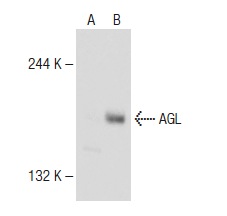
Western blot analysis of AGL expression in non-transfected: (A) and mouse AGL transfected: (B) 293T whole cell lysates.| Product Name | AGL Antibody (C-18) |
|---|---|
| Antibody Type | Primary Antibodies |
| Modification Notes | AGL (amylo-1, 6-glucosidase, 4-alpha-glucanotransferase), also known as GDE (Glycogen debranching enzyme), is a 1,532 amino acid protein that exists as three alternatively spliced isoforms which are expressed in kidney, liver, heart and muscle in an isoform-specific manner. Exhibiting multifunctional enzyme capabilities, AGL contains two catalytic active sites, one of which acts as an 4-alpha-glucotransferase and the other of which acts as an amylo-1,6-glucosidase during glycogen degradation. Defects in the gene encoding AGL are the cause of glycogen storage disease type 3 (GSD3), also known as Forbes disease. GSD3 is a metabolic disorder that is characterized by the presence of abnormal glycogen due to a lack of AGL activity. Symptoms of GSD3 generally include hypoglycemia, variable myopathy, hepatomegaly and short stature. |
| Clonality | Polyclonal |
|---|---|
| Isotype | IgG |
| Host Species | Rabbit |
| Tested Applications | WBIPELISA |
| Species Reactivity | HumanMouseRat |
| Concentration | 1mg/ml |
| Purification | Affinity purified |
| Alternative Names | recommended for detection of AGL of human origin by WB IP and ELISA |
|---|---|
| Tissue Specificity | recommended for detection of AGL of human origin by WB, IP and ELISA |
| Entrez Gene | 178 |
|---|
Application
Western blot analysis of AGL expression in non-transfected: (A) and mouse AGL transfected: (B) 293T whole cell lysates.| Form | Liquid |
|---|---|
| Storage Instructions | For short-term storage, store at 4° C. For long-term storage, aliquot and store at -20ºC or below. Avoid multiple freeze-thaw cycles. |
| Storage Buffer | phosphate buffered saline , pH 7.4, 150mM NaCl, 0.02% sodium azide and 50% glycerol. |


