Application
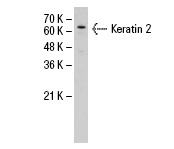
Western blot analysis of Keratin 2 expression in Jurkat whole cell lysate.Application
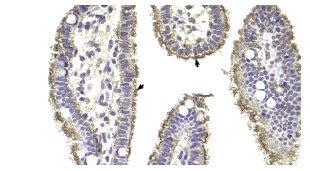
Immunoperoxidase staining of formalin fixed, paraffin-embedded human intestine tissue showing cytoplasmic staining.| Product Name | Keratin 2 Antibody (U-25) |
|---|---|
| Antibody Type | Primary Antibodies |
| Antigen Alias | raised against Keratin 2 of human origin |
| Modification Notes | The keratin multigene family is made of “soft” epithelial cytokeratins and “hard” hair keratins. While the epithelial cytokeratins are involved in the layering and formation of epithelia, the hair keratins are responsible for creating nails and hair. There are two types of keratins: the acidic class I keratin proteins and the basic/neutral class II keratin proteins. Keratin 2 (KRT2), also known as Keratin type II cytoskeletal 2 epidermal, Keratin-2e (K2e), KRTE, Cytokeratin-2e (CK-2e), KRT2A or KRT2E, is a 639 amino acid class II epithelial Keratin protein belonging to the intermediate filament family. Encoded by a gene that maps to human chromosome 12q13.13, Keratin 2 functions in epidermal keratinocyte activation and proliferation, and plays a part in terminal cornification. Highly expressed in upper epithelial tissues, Keratin 2 forms heterotetramers with two class I Keratins and another class II Keratin. Defects in Keratin 2 have been linked to ichthyosis bullosa of Siemens (IBS), a rare autosomal dominant skin disorder. |
| Clonality | Polyclonal |
|---|---|
| Isotype | IgG |
| Host Species | Rabbit |
| Tested Applications | WBIPIFIHCELISA |
| recommended for detection of Keratin 2 of human and canine origin by WB, IP, IF, IHC(P) and ELISA: |
|
| Species Reactivity | HumanMouseRat |
| Concentration | 1mg/ml |
| Purification | Affinity purified |
| Alternative Names | raised against Keratin 2 of human origin |
|---|---|
| Tissue Specificity | raised against Keratin 2 of human origin |
| Entrez Gene | 3849 |
|---|
Application
Western blot analysis of Keratin 2 expression in Jurkat whole cell lysate.
Application
Immunoperoxidase staining of formalin fixed, paraffin-embedded human intestine tissue showing cytoplasmic staining.| Application Notes | recommended for detection of Keratin 2 of human and canine origin by WB, IP, IF, IHC(P) and ELISA: |
|---|
| Form | Liquid |
|---|---|
| Storage Instructions | For short-term storage, store at 4° C. For long-term storage, aliquot and store at -20ºC or below. Avoid multiple freeze-thaw cycles. |
| Storage Buffer | phosphate buffered saline , pH 7.4, 150mM NaCl, 0.02% sodium azide and 50% glycerol. |


