Application
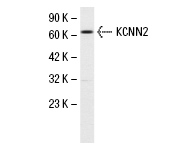
Western blot analysis of KCNN2 expression in Hep G2 whole cell lysate.| Product Name | KCNN2 Antibody (U-24) |
|---|---|
| Antibody Type | Primary Antibodies |
| Antigen Alias | raised against KCNN2 of human origin |
| Modification Notes | Immediately following action potentials in vertebrate neurons, calcium-activated potassium channels mediate the afterhyperpolarization (AHP) that dictates the firing pattern of the neuron. KCCN2, also known as Small conductance calcium-activated potassium channel protein 2 (SK2), is a voltage-independent potassium channel that is activated by calcium prior to the AHP. By contributing to the slow component of synaptic AHP, KCCN2 is believed to regulate neuron excitability. As a widely expressed integral membrane protein, KCCN2 forms a heterooligomer composed of three other channel subunits, where each subunit is bound to a calcium-binding calmodulin subunit. KCCN2 activity can be blocked by the neurotoxins tubocurarine, apamin and scyllatoxin. |
| Clonality | Polyclonal |
|---|---|
| Isotype | IgG |
| Host Species | Rabbit |
| Tested Applications | WBIPELISA |
| recommended for detection of KCNN2 of human origin by WB, IP and ELISA: |
|
| Species Reactivity | HumanMouseRat |
| Concentration | 1mg/ml |
| Purification | Affinity purified |
| Alternative Names | raised against KCNN2 of human origin |
|---|---|
| Tissue Specificity | raised against KCNN2 of human origin |
| Entrez Gene | 3781 |
|---|
Application
Western blot analysis of KCNN2 expression in Hep G2 whole cell lysate.| Application Notes | recommended for detection of KCNN2 of human origin by WB, IP and ELISA: |
|---|
| Form | Liquid |
|---|---|
| Storage Instructions | For short-term storage, store at 4° C. For long-term storage, aliquot and store at -20ºC or below. Avoid multiple freeze-thaw cycles. |
| Storage Buffer | phosphate buffered saline , pH 7.4, 150mM NaCl, 0.02% sodium azide and 50% glycerol. |


