Application
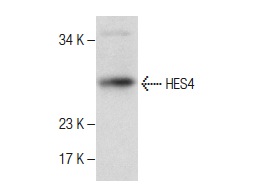
Western blot analysis of HES4 expression in human stomach tissue extract.| Product Name | HES4 Antibody (H-60) |
|---|---|
| Antibody Type | Primary Antibodies |
| Antigen Alias | epitope corresponding to amino acids 142-221 mapping near the C-terminus of HES4 of human origin |
| Modification Notes | The Drosophila hairy and Enhancer of split genes encode basic helix-loop-helix (bHLH) transcriptional repressors that function in the Notch signaling pathway and control segmentation and neural development during embryogenesis. The mammalian homologues of Drosophila hairy and Enhancer of split are the HES gene family members, HES1-6, which also encode bHLH transcriptional repressors that regulate myogenesis and neurogenesis. The HES family members form a complex with TLE, the mammalian homologue of Groucho, and this interaction is mediated by the carboxy terminal WRPW motif of the HES proteins. The HES/TLE complex functions by directly binding to DNA, instead of interfering with activator proteins. Most HES family members, including HES1 and HES5, preferentially bind to the N box (CACNAG) as opposed to the E box (CANNTG). HES2 binds to both N and E box sites, while HES6 does not bind DNA. Rather, HES6 inhibits HES1 activity, thereby promoting transcription. HES1 and HES2 are expressed in a variety of adult and embryonic tissues. HES3 is expressed exclusively in cerebellar Purkinje cells, and HES5 is found solely in the nervous system. HES6 is produced in brain as well as in the limb buds of developing embryos. |
| Clonality | Polyclonal |
|---|---|
| Isotype | IgG |
| Host Species | Rabbit |
| Tested Applications | WBIPIFELISA |
| recommended for detection of HES4 of human origin by WB, IP, IF and ELISA: |
|
| Species Reactivity | HumanMouseRat |
| Concentration | 1mg/ml |
| Purification | Affinity purified |
| Alternative Names | epitope corresponding to amino acids 142-221 mapping near the C-terminus of HES4 of human origin |
|---|---|
| Tissue Specificity | epitope corresponding to amino acids 142-221 mapping near the C-terminus of HES4 of human origin |
| Entrez Gene | 57801 |
|---|
Application
Western blot analysis of HES4 expression in human stomach tissue extract.| Application Notes | recommended for detection of HES4 of human origin by WB, IP, IF and ELISA: |
|---|
| Form | Liquid |
|---|---|
| Storage Instructions | For short-term storage, store at 4° C. For long-term storage, aliquot and store at -20ºC or below. Avoid multiple freeze-thaw cycles. |
| Storage Buffer | phosphate buffered saline , pH 7.4, 150mM NaCl, 0.02% sodium azide and 50% glycerol. |


