Application
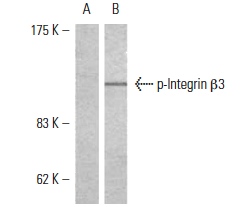
Western blot analysis of phosphorylated Integrin β3 expression in untreated (A) and Insulin-treated (B) A-431 whole cell lysates.| Product Name | p-Integrin β3 Antibody (Tyr 759) |
|---|---|
| Antibody Type | Primary Antibodies |
| Antigen Alias | epitope corresponding to phosphorylated Tyr 759 of Integrin β3 of human origin |
| Modification | Phosphoralated |
| Modification Notes | Integrins are heterodimers composed of noncovalently associated transmembrane a and b subunits. The 16 å and 8 ∫ subunits heterodimerize to produce more than 20 different receptors (1,2). Most integrin receptors bind ligands that are components of the extracellular matrix, but can also bind to soluble ligands or to counterreceptors on adjacent cells, thereby leading to aggregation of cells (2). Ligands serve to cross-link or cluster integrins by binding to adjacent integrin receptors (3). In addition to mediating cell adhesion and cytoskeletal organization, integrins function as signaling receptors. Signals transduced by integrins play a role in many biological processes, including cell growth, differentiation, migration and apoptosis (4,5). GRB2 binds Integrin ∫3 only when both Tyr 747 and Tyr 759 are phosphorylated (6). However, SHC binds the monophosphorylated Integrin ∫3 at Tyr 759, suggesting that tyrosine phosphorylation of Integrin ∫3 may be important in intiating outside-in signaling cascades by inducing association of signaling components directly with Integrin (6). |
| Clonality | Polyclonal |
|---|---|
| Isotype | IgG |
| Host Species | Rabbit |
| Tested Applications | WBIP |
| recommended for detection of Tyr 759 phosphorylated Integrin β3 of mouse, rat and human origin by WB and IP: |
|
| Species Reactivity | HumanMouseRat |
| Concentration | 1mg/ml |
| Purification | Affinity purified |
| Alternative Names | epitope corresponding to phosphorylated Tyr 759 of Integrin &beta 3 of human origin |
|---|---|
| Tissue Specificity | epitope corresponding to phosphorylated Tyr 759 of Integrin β3 of human origin |
| Entrez Gene | 3690 |
|---|
Application
Western blot analysis of phosphorylated Integrin β3 expression in untreated (A) and Insulin-treated (B) A-431 whole cell lysates.| Application Notes | recommended for detection of Tyr 759 phosphorylated Integrin β3 of mouse, rat and human origin by WB and IP: |
|---|
| Form | Liquid |
|---|---|
| Storage Instructions | For short-term storage, store at 4° C. For long-term storage, aliquot and store at -20ºC or below. Avoid multiple freeze-thaw cycles. |
| Storage Buffer | phosphate buffered saline , pH 7.4, 150mM NaCl, 0.02% sodium azide and 50% glycerol. |


