Application
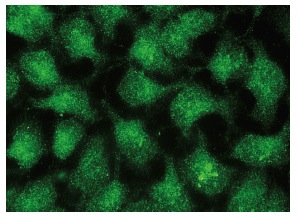
Immunofluorescence staining of methanol-fixed HeLa cells showing nuclear and cytoplasmic localization.Application
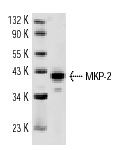
Western blot analysis of MKP-2 expression in PMA-induced RAW 264.7 whole cell lysate.| Product Name | MKP-2 Antibody (S-18) |
|---|---|
| Antibody Type | Primary Antibodies |
| Antigen Alias | epitope mapping at the C-terminus of MKP-2 of mouse origin |
| Modification Notes | MKP-2 (MAP kinase phosphatase 2, Dual specificity protein phosphatase 4 (DUSP4)) is a phoshpatase involved in the complex MAPKKK cascade. MKP-2 belongs to the protein-tyrosine phosphatase family (Non-receptor class dual specificity subfamily) and contains one rhodanese domain and one tyrosine-protein phosphatase domain. A dual specificity protein phosphatase, MKP-2 has a stringent substrate specificity for MAPKs. It acts to regulate mitogenic signal transduction by dephosphorylating both Thr and Tyr residues on MAP kinases ERK 1 and ERK 2. Transcription factor E2F-1, which is responsible for mediating apoptosis and suppressing tumorigenesis, acts as a transcriptional regulator of MKP-2. E2F-1 is physically associated with the MKP-2 promoter and can transactivate the promoter of the MKP-2 gene. Specifically, E2F-1 binds to a perfect palindromic motif in the MKP-2 promoter. MKP-2 is an essential cell death mediator in the E2F-1 pathway and may lead to the development of new strategies for cancer treatment. |
| Clonality | Polyclonal |
|---|---|
| Isotype | IgG |
| Host Species | Rabbit |
| Tested Applications | WBIPIFELISA |
| recommended for detection of MKP-2 of mouse, rat and human origin by WB, IP, IF and ELISA also reactive with additional species, including equine, canine, bovine and avian: |
|
| Species Reactivity | HumanMouseRat |
| Concentration | 1mg/ml |
| Purification | Affinity purified |
| Alternative Names | epitope mapping at the C-terminus of MKP-2 of mouse origin |
|---|---|
| Tissue Specificity | epitope mapping at the C-terminus of MKP-2 of mouse origin |
| Entrez Gene | 1846 |
|---|
Application
Immunofluorescence staining of methanol-fixed HeLa cells showing nuclear and cytoplasmic localization.
Application
Western blot analysis of MKP-2 expression in PMA-induced RAW 264.7 whole cell lysate.| Application Notes | recommended for detection of MKP-2 of mouse, rat and human origin by WB, IP, IF and ELISA also reactive with additional species, including equine, canine, bovine and avian: |
|---|
| Form | Liquid |
|---|---|
| Storage Instructions | For short-term storage, store at 4° C. For long-term storage, aliquot and store at -20ºC or below. Avoid multiple freeze-thaw cycles. |
| Storage Buffer | phosphate buffered saline , pH 7.4, 150mM NaCl, 0.02% sodium azide and 50% glycerol. |


