Application
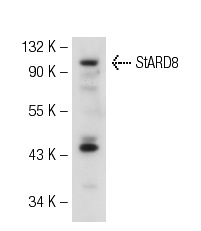
Western blot analysis of StARD8 expression in HeLa whole cell lysate.Application
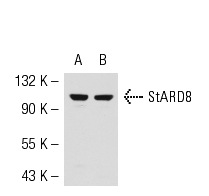
Western blot analysis of StARD8 expression in MES-SA/Dx5 (A) and U-87 MG (B) whole cell lysates.| Product Name | StARD8 Antibody (H-100) |
|---|---|
| Antibody Type | Primary Antibodies |
| Antigen Alias | epitope corresponding to amino acids 731-830 mapping within an internal region of StARD8 of human origin |
| Modification Notes | The StARD (steroidogenic acute regulatory protein-related lipid transfer (START) domain containing) family of proteins is comprised of fifteen different members. All members contain the characteristic START domain and are believed to play key roles in the metabolism and transport of lipids. The StARD proteins are grouped into six subfamilies based on their START domain sequences. StARD8, StARD12 and StARD13 constitute one subfamily, namely the RhoGAP START group. StARD8, also known as DLC3 (deleted in liver cancer protein 3) or STARTGAP3, is a RhoGAP protein specific for Rho A and Cdc42. Localizing to focal adhesions, StARD8 contains one RhoGAP domain, one SAM (sterile alpha motif) domain and one START domain. Overexpression of StARD8 in various cancer cell lines represses cell proliferation and colony formation, implying that StARD8 acts as a tumor suppressor and plays a role in the regulation of cell growth. |
| Clonality | Polyclonal |
|---|---|
| Isotype | IgG |
| Host Species | Rabbit |
| Tested Applications | WBIPIFELISA |
| recommended for detection of StAR-related lipid transfer protein 8 of mouse, rat and human origin by WB, IP, IF and ELISA also reactive with additional species, including equine, canine, bovine and porcine: |
|
| Species Reactivity | HumanMouseRat |
| Concentration | 1mg/ml |
| Purification | Affinity purified |
| Alternative Names | epitope corresponding to amino acids 731-830 mapping within an internal region of StARD8 of human origin |
|---|---|
| Tissue Specificity | epitope corresponding to amino acids 731-830 mapping within an internal region of StARD8 of human origin |
| Entrez Gene | 9754 |
|---|
Application
Western blot analysis of StARD8 expression in HeLa whole cell lysate.
Application
Western blot analysis of StARD8 expression in MES-SA/Dx5 (A) and U-87 MG (B) whole cell lysates.| Application Notes | recommended for detection of StAR-related lipid transfer protein 8 of mouse, rat and human origin by WB, IP, IF and ELISA also reactive with additional species, including equine, canine, bovine and porcine: |
|---|
| Form | Liquid |
|---|---|
| Storage Instructions | For short-term storage, store at 4° C. For long-term storage, aliquot and store at -20ºC or below. Avoid multiple freeze-thaw cycles. |
| Storage Buffer | phosphate buffered saline , pH 7.4, 150mM NaCl, 0.02% sodium azide and 50% glycerol. |


