Application
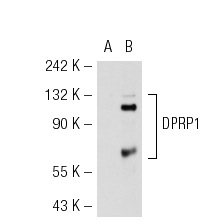
Western blot analysis of DPRP1 expression in non-transfected: (A) and human DPRP1 transfected: (B) 293T whole cell lysates.| Product Name | DPRP1 Antibody (H-70) |
|---|---|
| Antibody Type | Primary Antibodies |
| Antigen Alias | epitope corresponding to amino acids 11-80 mapping near the N-terminus of DPRP1 of human origin |
| Modification Notes | Dipeptidyl peptidases (DPPs) mediate regulatory activity of their substrates and have been linked to a variety of diseases including type 2 diabetes, obesity and cancer. DPPs have post-proline dipeptidyl aminopeptidase activity, cleaving Xaa-Pro dipeptides from the N-termini of proteins. DPPs can bind specific voltage-gated potassium channels and alter their expression and biophysical properties and may also influence T cells. DPP proteins include DPRP1, DPRP2, DPP3, DPP7, DPP10, DPPX and CD26. DPRP1 (dipeptidyl-peptidase IV-related protein 1), also known as DPP8 (dipeptidyl-peptidase 8), DP8 or MSTP141, is a member of the peptidase S9B family of proteins that exhibit prolyl oligopeptidase activity. DPRP1 localizes to the cytoplasm and is ubiquitously expressed with predominant expression in placenta, brain, prostate, testis and muscle. DPRP1 is similar to CD26 (dipeptidyl peptidase IV) suggesting that it may be involved in immune function and participate in the activation of T-cells. |
| Clonality | Polyclonal |
|---|---|
| Isotype | IgG |
| Host Species | Rabbit |
| Tested Applications | WBIPIFELISA |
| recommended for detection of DPRP1 of mouse, rat and human origin by WB, IP, IF and ELISA also reactive with additional species, including equine, canine, bovine and porcine: |
|
| Species Reactivity | HumanMouseRat |
| Concentration | 1mg/ml |
| Purification | Affinity purified |
| Alternative Names | epitope corresponding to amino acids 11-80 mapping near the N-terminus of DPRP1 of human origin |
|---|---|
| Tissue Specificity | epitope corresponding to amino acids 11-80 mapping near the N-terminus of DPRP1 of human origin |
| Entrez Gene | 54878 |
|---|
Application
Western blot analysis of DPRP1 expression in non-transfected: (A) and human DPRP1 transfected: (B) 293T whole cell lysates.| Application Notes | recommended for detection of DPRP1 of mouse, rat and human origin by WB, IP, IF and ELISA also reactive with additional species, including equine, canine, bovine and porcine: |
|---|
| Form | Liquid |
|---|---|
| Storage Instructions | For short-term storage, store at 4° C. For long-term storage, aliquot and store at -20ºC or below. Avoid multiple freeze-thaw cycles. |
| Storage Buffer | phosphate buffered saline , pH 7.4, 150mM NaCl, 0.02% sodium azide and 50% glycerol. |


