Application
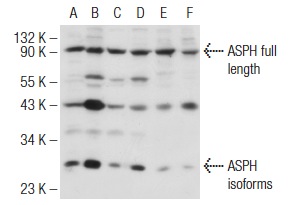
Western blot analysis of ASPH expression in HeLa (A), AT-3 (B), PC-12 (C), KNRK (D), c4 (E) and A-10 (F) whole cell lysates.| Product Name | ASPH Antibody (H-300) |
|---|---|
| Antibody Type | Primary Antibodies |
| Modification Notes | Aspartyl/asparaginyl beta-hydroxylase (ASPH) is a widely-expressed type II membrane protein involved in calcium homeostasis. Located in the endoplasmic reticulum, ASPH specifically hydroxylates an Asp or Asn residue in the epidermal growth factor-like (EGF) domains of several proteins, using iron as a cofactor. The ASPH gene encodes 3 proteins, ASPH, Junctin, and Junctate (or Humbug), that differ significantly in their C-terminal domains. These ASPH gene products are expressed as five transcript variants that differ by their roles in calcium storage and release, hydroxylation capabilities, and tissue specificity. While all ASPH variants are expressed in skeletal muscle, only some are detected in heart, brain, pancreas, placenta, lung, liver, and kidney tissues. In the lumen of the endoplasmic reticulum, ASPH can be processed into two different forms. |
| Clonality | Polyclonal |
|---|---|
| Isotype | IgG |
| Host Species | Rabbit |
| Tested Applications | WBIPIFELISA |
| recommended for detection of ASPH of mouse, rat and human origin by WB, IP, IF and ELISA also reactive with additional species, including equine, bovine and porcine | |
| Species Reactivity | HumanMouseRat |
| Concentration | 1mg/ml |
| Purification | Affinity purified |
| Alternative Names | epitope corresponding to amino acids 382-681 mapping within an internal region of ASPH of human origin |
|---|---|
| Tissue Specificity | epitope corresponding to amino acids 382-681 mapping within an internal region of ASPH of human origin |
| Entrez Gene | 444 |
|---|
Application
Western blot analysis of ASPH expression in HeLa (A), AT-3 (B), PC-12 (C), KNRK (D), c4 (E) and A-10 (F) whole cell lysates.| Application Notes | recommended for detection of ASPH of mouse, rat and human origin by WB, IP, IF and ELISA also reactive with additional species, including equine, bovine and porcine |
|---|
| Form | Liquid |
|---|---|
| Storage Instructions | For short-term storage, store at 4° C. For long-term storage, aliquot and store at -20ºC or below. Avoid multiple freeze-thaw cycles. |
| Storage Buffer | phosphate buffered saline , pH 7.4, 150mM NaCl, 0.02% sodium azide and 50% glycerol. |


