Application
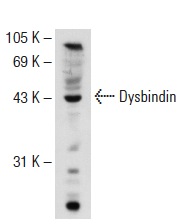
Western blot analysis of Dysbindin expression in Hep G2 whole cell lysate.Application
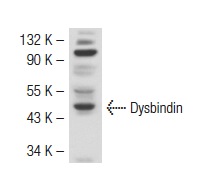
Western blot analysis of Dysbindin expression in 293T whole cell lysate.| Product Name | Dysbindin Antibody (H-90) |
|---|---|
| Antibody Type | Primary Antibodies |
| Modification Notes | Hermansky-Pudlak syndrome (HPS) is a rare, genetically heterogeneous, autosomal recessive disorder. It is characterized by oculocutaneous albinism, lysosomal storage defects and prolonged bleeding due to platelet storage pool deficiency. HPS is a result of defects in various cytoplasmic organelles such as melanosomes, platelet dense granules and lysosomes. The HPS proteins, including HPS-1-6 and Dysbindin (also designated HPS-7), all interact within three distinct, ubiquitously expressed protein complexes or biogenesis of lysosome-related organelle complexes. Defects in the genes encoding for these proteins are the cause of HPS. Dysbindin binds to dystrobrevins in the dystrophin-associated protein complex (DPC) complex. Dysbindin is a cytoplasmic protein. Isoforms 1 and 2 are the result of alternative splicing. |
| Clonality | Polyclonal |
|---|---|
| Isotype | IgG |
| Host Species | Rabbit |
| Tested Applications | WBIPIFELISA |
| recommended for detection of Dysbindin isoforms 1 and 2 of mouse, rat and human origin by WB, IP, IF and ELISA also reactive with additional species, including bovine and porcine | |
| Species Reactivity | HumanMouseRat |
| Concentration | 1mg/ml |
| Purification | Affinity purified |
| Alternative Names | epitope corresponding to amino acids 1-90 mapping at the N-terminus of Dysbindin of human origin |
|---|---|
| Tissue Specificity | epitope corresponding to amino acids 1-90 mapping at the N-terminus of Dysbindin of human origin |
| Entrez Gene | 84062 |
|---|
Application
Western blot analysis of Dysbindin expression in Hep G2 whole cell lysate.
Application
Western blot analysis of Dysbindin expression in 293T whole cell lysate.| Application Notes | recommended for detection of Dysbindin isoforms 1 and 2 of mouse, rat and human origin by WB, IP, IF and ELISA also reactive with additional species, including bovine and porcine |
|---|
| Form | Liquid |
|---|---|
| Storage Instructions | For short-term storage, store at 4° C. For long-term storage, aliquot and store at -20ºC or below. Avoid multiple freeze-thaw cycles. |
| Storage Buffer | phosphate buffered saline , pH 7.4, 150mM NaCl, 0.02% sodium azide and 50% glycerol. |


