Application
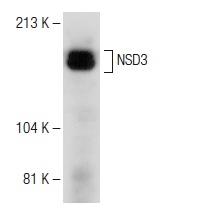
Western blot analysis of NSD3 expression in rat heart tissue extract.| Product Name | NSD3 Antibody (H-300) |
|---|---|
| Antibody Type | Primary Antibodies |
| Modification Notes | The deduced 1,437 amino acid NSD3 protein contains two PWWP domains involved in protein-protein interactions, five PHD-type zinc finger motifs found in chromatin-associated proteins, a SAC (SET-associated cys-rich) domain, a SET domain and a C-terminal C5HCH domain. Two NSD3 variants have been identified. The short variant comprised of 645 amino acids, arises from alternative polyadenylation and exon splicing and contains a single PWWP domain. A longer NSD3 variant, which is only expressed in HeLa cells, is comprised of 1,388 amino acid residues. The human WHSC1L1 gene, which encodes the NSD3 protein, shares 68% and 55% identity with mouse Nsd1 and human WHSC1, respectively. Highest expression of NSD3 is observed in brain, heart and skeletal muscle tissues; lower levels of NSD3 expression are observed in the liver and lungs. |
| Clonality | Polyclonal |
|---|---|
| Isotype | IgG |
| Host Species | Rabbit |
| Tested Applications | WBIPIFELISA |
| recommended for detection of NSD3 of mouse, rat and human origin by WB, IP, IF and ELISA also reactive with additional species, including equine, canine, bovine and porcine | |
| Species Reactivity | HumanMouseRat |
| Concentration | 1mg/ml |
| Purification | Affinity purified |
| Alternative Names | epitope corresponding to amino acids 319-618 mapping within an internal region of NSD3 of human origin |
|---|---|
| Tissue Specificity | epitope corresponding to amino acids 319-618 mapping within an internal region of NSD3 of human origin |
| Entrez Gene | 54904 |
|---|
Application
Western blot analysis of NSD3 expression in rat heart tissue extract.| Application Notes | recommended for detection of NSD3 of mouse, rat and human origin by WB, IP, IF and ELISA also reactive with additional species, including equine, canine, bovine and porcine |
|---|
| Form | Liquid |
|---|---|
| Storage Instructions | For short-term storage, store at 4° C. For long-term storage, aliquot and store at -20ºC or below. Avoid multiple freeze-thaw cycles. |
| Storage Buffer | phosphate buffered saline , pH 7.4, 150mM NaCl, 0.02% sodium azide and 50% glycerol. |


