Application
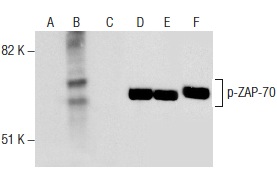
Antibodies tested include p-ZAP-70 (Tyr 493): (A,B,C) and ZAP-70 (1E7.2): (D,E,F).Application
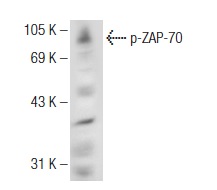
Western blot analysis of ZAP-70 phosphoryation in Jurkat whole cell lysate.| Product Name | p-ZAP-70 Antibody (Tyr 493) |
|---|---|
| Antibody Type | Primary Antibodies |
| Modification Notes | The activation of T lymphocytes by antigens is mediated by the T cell receptor (TCR), which is a multisubunit complex assembled from at least six different genes (1,2). The TCR subunits include the Ti a and b chains, the CD3 g , d and e chains and a z -containing homodimer or heterodimer (1,2). The protein tyrosine kinase ZAP-70 binds to the phosphorylated immunoreceptor tyrosine-base activation motifs (ITAMs) of the TCR z chain through two src-homology (SH2) domains (3,4). This binding results in the phosphorylation of ZAP-70 on multiple tyrosine residues, including Tyr292 and Tyr319 (4). ZAP-70 is autophosphorylated on Tyr292, which is thought to negatively regulate ZAP-70 function in lymphocytes (5,6). Alternatively, ZAP-70 is positively regulated by phosphorylation on Tyr319, which mediates the SH2-dependent interaction between Lck and ZAP-70 (5,6). |
| Clonality | Polyclonal |
|---|---|
| Isotype | IgG |
| Host Species | Rabbit |
| Tested Applications | WBIPIFELISA |
| recommended for detection of Tyr 493 phosphorylated ZAP-70 of mouse, rat and human origin by WB, IP, IF and ELISA | |
| Species Reactivity | HumanMouseRat |
| Concentration | 1mg/ml |
| Purification | Affinity purified |
| Alternative Names | epitope corresponding to phosphorylated Tyr 493 of ZAP-70 of human origin |
|---|---|
| Tissue Specificity | epitope corresponding to phosphorylated Tyr 493 of ZAP-70 of human origin |
| Entrez Gene | 7535 |
|---|
Application
Antibodies tested include p-ZAP-70 (Tyr 493): (A,B,C) and ZAP-70 (1E7.2): (D,E,F).
Application
Western blot analysis of ZAP-70 phosphoryation in Jurkat whole cell lysate.| Application Notes | recommended for detection of Tyr 493 phosphorylated ZAP-70 of mouse, rat and human origin by WB, IP, IF and ELISA |
|---|
| Form | Liquid |
|---|---|
| Storage Instructions | For short-term storage, store at 4° C. For long-term storage, aliquot and store at -20ºC or below. Avoid multiple freeze-thaw cycles. |
| Storage Buffer | phosphate buffered saline , pH 7.4, 150mM NaCl, 0.02% sodium azide and 50% glycerol. |


