Application
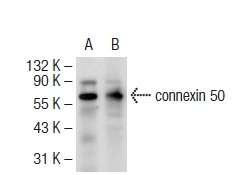
Western blot analysis of connexin 50 expression in mouse eye (A) and rat eye (B) tissue extracts.| Product Name | connexin 50 Antibody (H-65) |
|---|---|
| Antibody Type | Primary Antibodies |
| Modification Notes | The connexin family of proteins form hexameric complexes called “connexons” that facilitate movement of low molecular weight proteins between cells via gap junctions (1). Connexin proteins share a common topology of 4 transmembrane alpha-helical domains, two extracellular loops, a cytoplasmic loop, and cytoplasmic N- and C-termini (2). Many of the key functional differences arise from specific amino-acid substitutions in the most highly conserved domains, the transmembrane and extracellular regions (2). Each of the approximately 20 connexin isoforms produces channels with distinct permeabilities and electrical and chemical sensitivities; therefore, one connexin usually cannot fully substitute for another (2). Consequently, a wide variety of malignant phenotypes associate with decreased connexin expression and gap junction communication, dependent on the particular connexin that is effected (3, 2). For instance, deletion of the gene encoding connexin 50, normally expressed in the lens, produces cataracts, though not as severe as with deletion of connexin 46 (4). |
| Clonality | Polyclonal |
|---|---|
| Isotype | IgG |
| Host Species | Rabbit |
| Tested Applications | WBIPIFELISA |
| recommended for detection of connexin 50 of mouse, rat and human origin by WB, IP, IF and ELISA also reactive with additional species, including equine, canine and bovine | |
| Species Reactivity | HumanMouseRat |
| Concentration | 1mg/ml |
| Purification | Affinity purified |
| Alternative Names | epitope corresponding to amino acids 228-292 mapping within a cytoplasmic domain of connexin 50 of human origin |
|---|---|
| Tissue Specificity | epitope corresponding to amino acids 228-292 mapping within a cytoplasmic domain of connexin 50 of human origin |
| Entrez Gene | 2703 |
|---|
Application
Western blot analysis of connexin 50 expression in mouse eye (A) and rat eye (B) tissue extracts.| Application Notes | recommended for detection of connexin 50 of mouse, rat and human origin by WB, IP, IF and ELISA also reactive with additional species, including equine, canine and bovine |
|---|
| Form | Liquid |
|---|---|
| Storage Instructions | For short-term storage, store at 4° C. For long-term storage, aliquot and store at -20ºC or below. Avoid multiple freeze-thaw cycles. |
| Storage Buffer | phosphate buffered saline , pH 7.4, 150mM NaCl, 0.02% sodium azide and 50% glycerol. |


