Application
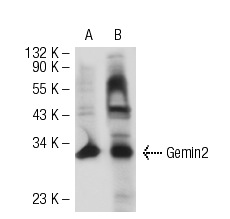
Western blot analysis of Gemin2 expression in 293T (A) and HeLa (B) whole cell lysates.| Product Name | Gemin2 Antibody (H-100) |
|---|---|
| Antibody Type | Primary Antibodies |
| Modification Notes | Spinal muscular atrophy (SMA) is an autosomal recessive neurodegenerative disease characterized by loss of motor neurons in the spinal cord. SMA is caused by deletion or loss-of-function mutations in the SMN (survival of motor neuron) gene. Gemin2 (formerly known as SIP1 for SMN interacting protein) associates directly with SMN and is a part of the SMN complex containing Gemin3 (a DEAD-box RNA helicase), Gemin4, Gemin5 and Gemin6, as well as several spliceosomal snRNP proteins. The SMN complex plays an essential role in splicesomal snRNP assembly in the cytoplasm and is required for pre-mRNA splicing of the nucleus. It is found in both the cytoplasm and the nucleus. The nuclear form is concentrated in subnuclear bodies called gems (Gemini of the coiled bodies). The SMN-Gemin2 complex is associated with spliceosomal snRNAs U1 and U5. Gemin2 is expressed in spinal cord. It can be induced by TGF∫ treatment and expression is high in several E-cadherin negative human carcinoma cell lines. SMN is expressed in a wide variety of tissues including brain, kidney, liver and spinal cord, and moderately in skeletal and cardiac muscle. The gene encoding Gemin2 maps to human chromosome 14q13. |
| Clonality | Polyclonal |
|---|---|
| Isotype | IgG |
| Host Species | Rabbit |
| Tested Applications | WBIPIFELISA |
| recommended for detection of Gemin2 of mouse, rat and human origin by WB, IP, IF and ELISA also reactive with additional species, including equine, bovine and porcine | |
| Species Reactivity | HumanMouseRat |
| Concentration | 1mg/ml |
| Purification | Affinity purified |
| Alternative Names | epitope corresponding to amino acids 2-101 mapping at the N-terminus of Gemin2 of human origin |
|---|---|
| Tissue Specificity | epitope corresponding to amino acids 2-101 mapping at the N-terminus of Gemin2 of human origin |
| Entrez Gene | 8487 |
|---|
Application
Western blot analysis of Gemin2 expression in 293T (A) and HeLa (B) whole cell lysates.| Application Notes | recommended for detection of Gemin2 of mouse, rat and human origin by WB, IP, IF and ELISA also reactive with additional species, including equine, bovine and porcine |
|---|
| Form | Liquid |
|---|---|
| Storage Instructions | For short-term storage, store at 4° C. For long-term storage, aliquot and store at -20ºC or below. Avoid multiple freeze-thaw cycles. |
| Storage Buffer | phosphate buffered saline , pH 7.4, 150mM NaCl, 0.02% sodium azide and 50% glycerol. |


