Application
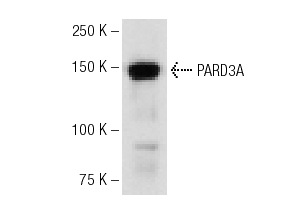
Western blot analysis of PARD3A expression in mouse brain tissue extract.| Product Name | PARD3A Antibody (H-70) |
|---|---|
| Antibody Type | Primary Antibodies |
| Modification Notes | Cellular asymmetry is critical for the development of multicellular organisms. PARD (partitioning-defective) proteins play important roles in asymmetric cell division and polarized growth. PARD3A (partitioning-defective 3), also known as Baz, ASIP (atypical PKC isotype-specific-interacting protein), PAR3, PARD3, PAR3å, Bazooka, SE2-5T2, SE2-5L16 or SE2-5LT1, is a 1,356 amino acid protein that contains three PDZ domains and belongs to the PAR3 family of proteins. Expressed in a wide variety of tissues, PARD3A colocalizes with PARD6A/B and PKC î at epithelial tight junctions and is believed to function as an adapter protein with an important role in the formation of normal tight junctions at epithelial cell-cell contacts. Due to alternative splicing events, PARD3A exists in at least ten isoforms, namely isoform A, isoform B, isoform C, isoform D, isoform E, isoform F, isoform Lb, isoform Sa, isoform Sb and isoform 10. |
| Clonality | Polyclonal |
|---|---|
| Isotype | IgG |
| Host Species | Rabbit |
| Tested Applications | WBIPIFELISA |
| recommended for detection of PARD3A of mouse, rat and human origin by WB, IP, IF and ELISA also reactive with additional species, including canine, bovine and avian | |
| Species Reactivity | HumanMouseRat |
| Concentration | 1mg/ml |
| Purification | Affinity purified |
| Alternative Names | epitope corresponding to amino acids 57-126 mapping near the N-terminus of PARD3A of human origin |
|---|---|
| Tissue Specificity | epitope corresponding to amino acids 57-126 mapping near the N-terminus of PARD3A of human origin |
| Entrez Gene | 56288 |
|---|
Application
Western blot analysis of PARD3A expression in mouse brain tissue extract.| Application Notes | recommended for detection of PARD3A of mouse, rat and human origin by WB, IP, IF and ELISA also reactive with additional species, including canine, bovine and avian |
|---|
| Form | Liquid |
|---|---|
| Storage Instructions | For short-term storage, store at 4° C. For long-term storage, aliquot and store at -20ºC or below. Avoid multiple freeze-thaw cycles. |
| Storage Buffer | phosphate buffered saline , pH 7.4, 150mM NaCl, 0.02% sodium azide and 50% glycerol. |


