Application
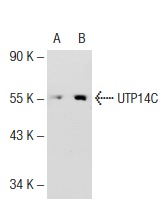
Western blot analysis of UTP14C expression in non-transfected: (A) and human UTP14C transfected: (B) 293T whole cell lysates.| Product Name | UTP14C Antibody (P-20) |
|---|---|
| Antibody Type | Primary Antibodies |
| Modification Notes | UTP14C (UTP14, U3 small nucleolar ribonucleoprotein), also known as UTP14B, is a 766 amino acid protein that localizes to the nucleolus and belongs to the UTP14 family. Expressed in testicular tissue, UTP14C functions as an essential component of spermatogenesis and is specifically required for ribosome biogenesis and protein synthesis during male meiosis. UTP14A, a related protein, may also be required for ribosome biogenesis, but not necessarily in a male-specific manner. The gene encoding UTP14C maps to human chromosome 13, which houses over 400 genes, such as BRCA2 and RB1, and comprises nearly 4% of the human genome. As with most chromosomes, polysomy of part or all of chromosome 13 is deleterious to development and decreases the odds of survival. Trisomy 13, also known as Patau syndrome, is deadly and the few who survive past one year suffer from permanent neurologic defects, difficulty eating and vulnerability to serious respiratory infections. |
| Clonality | Polyclonal |
|---|---|
| Isotype | IgG |
| Host Species | Rabbit |
| Tested Applications | WBIPIFELISA |
| recommended for detection of UTP14C and UTP14A of human origin by WB, IP, IF and ELISA also reactive with additional species, including equine, canine, bovine and porcine | |
| Species Reactivity | HumanMouseRat |
| Concentration | 1mg/ml |
| Purification | Affinity purified |
| Alternative Names | epitope mapping within an internal region of UTP14C of human origin |
|---|---|
| Tissue Specificity | epitope mapping within an internal region of UTP14C of human origin |
Application
Western blot analysis of UTP14C expression in non-transfected: (A) and human UTP14C transfected: (B) 293T whole cell lysates.| Application Notes | recommended for detection of UTP14C and UTP14A of human origin by WB, IP, IF and ELISA also reactive with additional species, including equine, canine, bovine and porcine |
|---|
| Form | Liquid |
|---|---|
| Storage Instructions | For short-term storage, store at 4° C. For long-term storage, aliquot and store at -20ºC or below. Avoid multiple freeze-thaw cycles. |
| Storage Buffer | phosphate buffered saline , pH 7.4, 150mM NaCl, 0.02% sodium azide and 50% glycerol. |


