Application
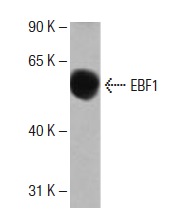
Western blot analysis of EBF1 expression in human fetal brain tissue extract.| Product Name | EBF1 Antibody (S-22) |
|---|---|
| Antibody Type | Primary Antibodies |
| Modification Notes | The mammalian olfactory system is composed of special sensory neurons within the olfactory epithelium. Mature sensory neurons express several olfactory-specific genes, many of which produce gene products essential to the odorant signal transduction cascade. Early B-cell factor 1 (EBF1), also known as COLLIER/OLF1/EBF transcription factor 1 (COE1) or Olfactory neuronal transcription factor 1 (OLF1), is a 591 amino acid protein belonging to the COE family. EBF1 has been identified as an olfactory-specific factor, which binds to olfactory-specific genes and coordinates their expression. EBF1 is also a tissue-specific and differentiation stage-specific factor that is involved in the development of B cells. Localized to the nucleus, EBF1 forms a homodimer or a heterodimer with a related family member. Activity of EBF1 can be blocked by interaction with ZNF423 and ZNF521, which prevent binding of EBF1 to DNA. EBF1 is expressed as two isoforms produced by alternative splicing. |
| Clonality | Polyclonal |
|---|---|
| Isotype | IgG |
| Host Species | Rabbit |
| Tested Applications | WBIPELISA |
| Species Reactivity | HumanMouseRat |
| Concentration | 1mg/ml |
| Purification | Affinity purified |
| Alternative Names | recommended for detection of EBF1 of mouse rat human Drosophila and C. elegans origin by WB IP and ELISA |
|---|---|
| Tissue Specificity | recommended for detection of EBF1 of mouse, rat, human, Drosophila and C. elegans origin by WB, IP and ELISA |
| Entrez Gene | 1879 |
|---|
Application
Western blot analysis of EBF1 expression in human fetal brain tissue extract.| Form | Liquid |
|---|---|
| Storage Instructions | For short-term storage, store at 4° C. For long-term storage, aliquot and store at -20ºC or below. Avoid multiple freeze-thaw cycles. |
| Storage Buffer | phosphate buffered saline , pH 7.4, 150mM NaCl, 0.02% sodium azide and 50% glycerol. |


