Application
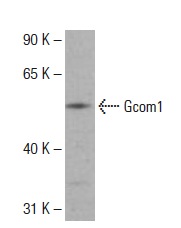
Western blot analysis of Gcom1 expression in 721 B whole cell lysate.| Product Name | Gcom1 Antibody (L-22) |
|---|---|
| Antibody Type | Primary Antibodies |
| Modification Notes | Glutamate receptors mediate most excitatory neurotransmission in the brain and play an important role in neural plasticity, neural development and neurodegeneration. Ionotropic glutamate receptors are categorized into NMDA receptors and kainate/AMPA receptors, both of which contain glutamate-gated, cation-specific ion channels. Synaptic and extrasynaptic NMDA receptors have been shown to have opposite effects on neuronal survival, CREB function and gene regulation. Gcom1 (GRINL1A complex locus protein 1), also known as GUP (GRINL1A upstream protein) and Gcom (GRINL1A combined protein), is a 466 amino acid protein that is a component of the GRINL1A complex transcription unit, which is thought to be involved in the modulation of glutamatergic neurotransmission through interaction with the NR1 subunit of the NMDA receptor. Gcom1 is expressed in small intestine, lung, liver, heart, skeletal muscle, testis and prostate and also colocalizes with NR1 in cortical and hippocampal neurons. There are eleven isoforms of Gcom1 that are produced as a result of alternative splicing events. |
| Clonality | Polyclonal |
|---|---|
| Isotype | IgG |
| Host Species | Rabbit |
| Tested Applications | WBIPELISA |
| Species Reactivity | HumanMouseRat |
| Concentration | 1mg/ml |
| Purification | Affinity purified |
| Alternative Names | recommended for detection of Gcom1 of human origin by WB IP and ELISA non cross-reactive with GRINL1A complex locus downstream isoforms including Gdown1 Gdown3 Gdown4 and Gdown6 |
|---|---|
| Tissue Specificity | recommended for detection of Gcom1 of human origin by WB, IP and ELISA; non cross-reactive with GRINL1A complex locus downstream isoforms, including Gdown1, Gdown3, Gdown4, and Gdown6 |
| Entrez Gene | 145781 |
|---|
Application
Western blot analysis of Gcom1 expression in 721 B whole cell lysate.| Form | Liquid |
|---|---|
| Storage Instructions | For short-term storage, store at 4° C. For long-term storage, aliquot and store at -20ºC or below. Avoid multiple freeze-thaw cycles. |
| Storage Buffer | phosphate buffered saline , pH 7.4, 150mM NaCl, 0.02% sodium azide and 50% glycerol. |


