Application
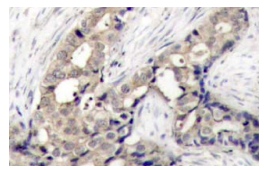
Immunoperoxidase staining of formalin-fixed, paraffin-embedded human breast carcinoma tissue showing cytoplasmic staining.| Product Name | p-c-Abl Antibody (Tyr 412) |
|---|---|
| Antibody Type | Primary Antibodies |
| Modification Notes | The Abl oncogene was initially identified as the viral transforming gene of Abelson murine leukemia virus (A-MuLV). The major translational product of c-Abl has been identified as a protein with tyrosine kinase activity and an SH2 domain. The Abl oncogene is implicated in several human leukemias including 90-95% of chronic myelocytic leukemia (CML), 20-25% of adult acute lymphoblastic leukemia (ALL) and 2-5% of pediatric ALL. In these leukemias the c-Abl proto-oncogene undergoes a (9;22) chromosomal translocation producing the Philadelphia (Ph1) chromosome. The molecular consequence of this trans-location is the generation of a chimeric Bcr/c-Abl mRNA encoding activated Abl protein-tyrosine kinase. The Bcr gene has been shown to encode a GTPase-activating protein (GAP) specific for the Ras-related GTP-binding protein, p21rac. |
| Clonality | Polyclonal |
|---|---|
| Isotype | IgG |
| Host Species | Rabbit |
| Tested Applications | IFIHC |
| recommended for detection of Tyr 412 phosphorylated c-Abl isoform IB and correspondingly phosphorylated Tyr 393 c-Abl isoform IA of mouse and human origin by IF and IHC(P) | |
| Species Reactivity | HumanMouseRat |
| Concentration | 1mg/ml |
| Purification | Affinity purified |
| Alternative Names | epitope corresponding to phosphorylated c-Abl isoform 2 of human origin |
|---|---|
| Tissue Specificity | epitope corresponding to phosphorylated c-Abl isoform 2 of human origin |
| Entrez Gene | 25 |
|---|
Application
Immunoperoxidase staining of formalin-fixed, paraffin-embedded human breast carcinoma tissue showing cytoplasmic staining.| Application Notes | recommended for detection of Tyr 412 phosphorylated c-Abl isoform IB and correspondingly phosphorylated Tyr 393 c-Abl isoform IA of mouse and human origin by IF and IHC(P) |
|---|
| Form | Liquid |
|---|---|
| Storage Instructions | For short-term storage, store at 4° C. For long-term storage, aliquot and store at -20ºC or below. Avoid multiple freeze-thaw cycles. |
| Storage Buffer | phosphate buffered saline , pH 7.4, 150mM NaCl, 0.02% sodium azide and 50% glycerol. |


