Application
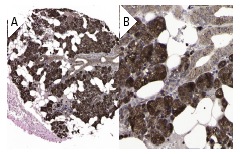
Western blot analysis of MEK-5 phosphorylation in rat testis tissue extract. Blots were probed with p-MEK-5 (Ser 311/Thr 315): (A) and p-MEK-5 (Ser 311/Thr 315): preincubated with its cognate phosphorylated peptide (B).| Product Name | p-MEK-5 Antibody (Ser 311/Thr 315) |
|---|---|
| Antibody Type | Primary Antibodies |
| Modification Notes | A family of protein kinases located upstream of the MAP kinases and responsible for their activation has been identified. The prototype member of this family, designated MAP kinase kinase, or MEK-1, specifically phosphorylates the MAP kinase regulatory threonine and tyrosine residues present in the Thr-Glu-Tyr motif of ERK. A second MEK family member, MEK-2, resembles MEK-1 in its substrate specificity. MEK-3 (or MKK-3) functions to activate p38 MAP kinase, and MEK-4 (also called SEK1 or MKK-4) activates both p38 and JNK MAP kinases. MEK-5 appears to specifically phosphorylate ERK5, whereas MEK-6 phosphorylates p38 and p38b. MEK-7 (or MKK-7) phosphorylates and activates the JNK signal transduction pathway. Phosphorylation of MEK-5 on specific serine or threonine residues, such as Ser 142, activates MEK-5 function. MEK-5 is activated by phosphorylation on serine and threonine residues by MLKs. Mouse, rat and human MEK-5 are subject to phosphorylation on Ser 311 and Thr 315. |
| Clonality | Polyclonal |
|---|---|
| Isotype | IgG |
| Host Species | Rabbit |
| Tested Applications | WBIP |
| Species Reactivity | HumanMouseRat |
| Concentration | 1mg/ml |
| Purification | Affinity purified |
| Alternative Names | recommended for detection of Ser 311 and Thr 315 dually phosphorylated MEK-5 of mouse rat human Xenopus and zebrafish origin by WB and IP also reactive with additional species including bovine and canine |
|---|---|
| Tissue Specificity | recommended for detection of Ser 311 and Thr 315 dually phosphorylated MEK-5 of mouse, rat, human, Xenopus and zebrafish origin by WB and IP; also reactive with additional species, including bovine and canine |
| Entrez Gene | 5607 |
|---|
Application
Western blot analysis of MEK-5 phosphorylation in rat testis tissue extract. Blots were probed with p-MEK-5 (Ser 311/Thr 315): (A) and p-MEK-5 (Ser 311/Thr 315): preincubated with its cognate phosphorylated peptide (B).| Form | Liquid |
|---|---|
| Storage Instructions | For short-term storage, store at 4° C. For long-term storage, aliquot and store at -20ºC or below. Avoid multiple freeze-thaw cycles. |
| Storage Buffer | phosphate buffered saline , pH 7.4, 150mM NaCl, 0.02% sodium azide and 50% glycerol. |


