Application
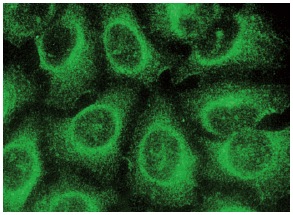
Immunofluorescence staining of methanol-fixed HeLa cells showing cytoplasmic localization.| Product Name | ghrelin Antibody (H-40) |
|---|---|
| Antibody Type | Primary Antibodies |
| Modification Notes | Small synthetic molecules called growth-hormone secretagogues (GHSs) act through GSH-R to stimulate the release of GH from the pituitary. Ghrelin is an endogenous ligand for the growth hormone secretagogue receptor (GHS-R). Ghrelin and GHRH are involved in the regulation of GH release from the pituitary. GHRH exerts its action through high-affinity GHRH receptors (GHRH-R) present in the anterior pituitary. The acylated peptide of ghrelin specifically releases GH both in vivo and in vitro and is found in stomach tissue. GH plays a crucial role in stimulating and controlling the growth, metabolism and differentiation of many mammalian cell types by modulating the synthesis of multiple mRNA species. The gene encoding ghrelin maps to human chromosome 3p26-p25. |
| Clonality | Polyclonal |
|---|---|
| Isotype | IgG |
| Host Species | Rabbit |
| Tested Applications | WBIPIFELISA |
| recommended for detection of precursor and mature ghrelin of mouse, rat and human origin by WB, IP, IF and ELISA also reactive with additional species, including canine and porcine | |
| Species Reactivity | HumanMouseRat |
| Concentration | 1mg/ml |
| Purification | Affinity purified |
| Alternative Names | epitope corresponding to amino acids 21-60 mapping at the N-terminus of ghrelin of human origin |
|---|---|
| Tissue Specificity | epitope corresponding to amino acids 21-60 mapping at the N-terminus of ghrelin of human origin |
| Entrez Gene | 51738 |
|---|
Application
Immunofluorescence staining of methanol-fixed HeLa cells showing cytoplasmic localization.| Application Notes | recommended for detection of precursor and mature ghrelin of mouse, rat and human origin by WB, IP, IF and ELISA also reactive with additional species, including canine and porcine |
|---|
| Form | Liquid |
|---|---|
| Storage Instructions | For short-term storage, store at 4° C. For long-term storage, aliquot and store at -20ºC or below. Avoid multiple freeze-thaw cycles. |
| Storage Buffer | phosphate buffered saline , pH 7.4, 150mM NaCl, 0.02% sodium azide and 50% glycerol. |


