Application
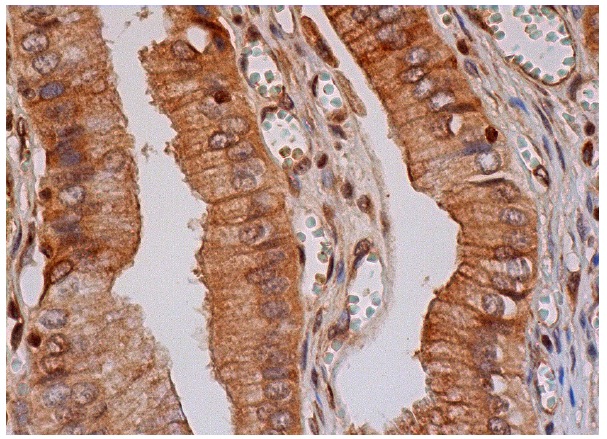
Immunoperoxidase staining of formalin fixed, paraffin-embedded human gall bladder tissue showing cytoplasmic and membrane staining of glandular cells.| Product Name | CHMP2A Antibody (H-105) |
|---|---|
| Antibody Type | Primary Antibodies |
| Modification Notes | The charged multivesicular body proteins, commonly designated CHMPs, belong to the vacuolar sorting protein family and function as chromatin-modifying proteins. CHMP1-6 are all components of ESCRT (endosomal sorting complex required for transport) I, II or III complexes. These complexes are crucial for sorting endosomal articles into multivesicular bodies (MVBs) and are also required for the formation of these bodies. CHMP2, also known as BC-2, associates directly with Vps4 for the disassembly of ESCRT-III complex in an ATP-dependant manner. During HIV-1 infection, the virus uses the ESCRT-III complex to mediate budding and exocytosis of viral proteins. Overexpression of CHMP2 strongly inhibits HIV-1 release. |
| Clonality | Polyclonal |
|---|---|
| Isotype | IgG |
| Host Species | Rabbit |
| Tested Applications | WBIPIFIHCELISA |
| recommended for detection of CHMP2 of mouse, rat and human origin by WB, IP, IF, IHC(P) and ELISA also reactive with additional species, including canine and bovine | |
| Species Reactivity | HumanMouseRat |
| Concentration | 1mg/ml |
| Purification | Affinity purified |
| Alternative Names | epitope corresponding to amino acids 51-155 mapping near the N-terminus of CHMP2 of human origin |
|---|---|
| Tissue Specificity | epitope corresponding to amino acids 51-155 mapping near the N-terminus of CHMP2 of human origin |
| Entrez Gene | 27243 |
|---|
Application
Immunoperoxidase staining of formalin fixed, paraffin-embedded human gall bladder tissue showing cytoplasmic and membrane staining of glandular cells.| Application Notes | recommended for detection of CHMP2 of mouse, rat and human origin by WB, IP, IF, IHC(P) and ELISA also reactive with additional species, including canine and bovine |
|---|
| Form | Liquid |
|---|---|
| Storage Instructions | For short-term storage, store at 4° C. For long-term storage, aliquot and store at -20ºC or below. Avoid multiple freeze-thaw cycles. |
| Storage Buffer | phosphate buffered saline , pH 7.4, 150mM NaCl, 0.02% sodium azide and 50% glycerol. |


