Application
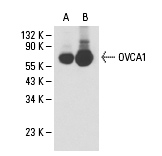
Western blot analysis of OVCA1 expression in mouse ovary (A) and rat ovary (B) tissue extracts.| Product Name | OVCA1 Antibody (H-300) |
|---|---|
| Antibody Type | Primary Antibodies |
| Modification Notes | OVCA1 (Ovarian cancer-associated gene 1 protein) is a nuclear protein that belongs to the DPH1/DPH2 family (DPH1 subfamily). Diphthamide is a modified histidine amino acid that is created by a posttranslational modification of eukaryotic elongation factor 2 (EF-2). Diphthamide is the target for ADP-ribosylation by diphtheria toxin, which renders the elongation factor inactive. The diphthamide modification is conserved in all eukaryotes and archaebacteria and is formed by the actions of five proteins, Dph1-5, and an amidating enzyme. OVCA1 (Dph-1) is required for the first step in the synthesis of diphthamide. The chromosomal region that contains OVCA1, 17p13.3, is frequently deleted in human ovarian carcinoma, suggesting this 15 kb region of deletion may contain a tumor suppressor gene. OVCA1 acts as a tumor suppressor in lung and breast cancers and when overexpressed will suppress colony formation and growth rate of ovarian cancer cells. OVCA1 is expressed in heart, brain, placenta, lung, liver, skeletal muscle, kidney, pancreas, spleen, thymus, mammary gland, colon, small intestine, testis and ovary. |
| Clonality | Polyclonal |
|---|---|
| Isotype | IgG |
| Host Species | Rabbit |
| Tested Applications | WBIPIFELISA |
| recommended for detection of OVCA1 of mouse, rat and human origin by WB, IP, IF and ELISA also reactive with additional species, including equine, canine, bovine and porcine | |
| Species Reactivity | HumanMouseRat |
| Concentration | 1mg/ml |
| Purification | Affinity purified |
| Alternative Names | epitope corresponding to amino acids 101-400 mapping within an internal region of OVCA1 of human origin |
|---|---|
| Tissue Specificity | epitope corresponding to amino acids 101-400 mapping within an internal region of OVCA1 of human origin |
| Entrez Gene | 1801 |
|---|
Application
Western blot analysis of OVCA1 expression in mouse ovary (A) and rat ovary (B) tissue extracts.| Application Notes | recommended for detection of OVCA1 of mouse, rat and human origin by WB, IP, IF and ELISA also reactive with additional species, including equine, canine, bovine and porcine |
|---|
| Form | Liquid |
|---|---|
| Storage Instructions | For short-term storage, store at 4° C. For long-term storage, aliquot and store at -20ºC or below. Avoid multiple freeze-thaw cycles. |
| Storage Buffer | phosphate buffered saline , pH 7.4, 150mM NaCl, 0.02% sodium azide and 50% glycerol. |


