Application
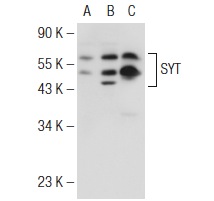
Western blot analysis of SYT expression in non-transfected 293T: (A), human SYT transfected 293T: (B) whole cell lysates and HeLa (C) nuclear extract.| Product Name | SYT Antibody (H-80) |
|---|---|
| Antibody Type | Primary Antibodies |
| Modification Notes | The transcriptional coactivator SYT (synovial translocation protein) contains a conserved amino terminal SNH domain and a carboxy terminal QPGY domain, which is a functioning transcriptional activating sequence. Synovial sarcoma translocation (SSX) proteins, including SSX1–5, are transcriptional repressors that contain a repressor domain in their carboxy termini. SSX proteins are localized to the nucleus and expressed in testis and several types of cancers and, therefore, they are classified as C/T (cancer/testis) antigens. The t(x;18) translocation results in the fusion of the amino terminus of SYT to the carboxy terminus of either SSX1 or SSX2; both fusions result in the production of transcriptional activators. SYT-SSX chimeras are detected in most synovial sarcomas. Synovial sarcomas are responsible for up to 10% of soft issue sarcomas and are histologically characterized as either biphasic or mono-phasic. Genetic analysis indicates that biphasic synovial sarcomas contain SYT-SSX1 fusions, whereas SYT-SSX2 fusions are found in monophasic synovial sarcomas, providing additional distinguishing characterization of these subtypes. |
| Clonality | Polyclonal |
|---|---|
| Isotype | IgG |
| Host Species | Rabbit |
| Tested Applications | WBIPIFELISAGSChIP |
| recommended for detection of SYT and SYT homolog-1 of mouse, rat and human origin by WB, IP, IF and ELISA | |
| Species Reactivity | HumanMouseRat |
| Concentration | 1mg/ml |
| Purification | Affinity purified |
| Alternative Names | epitope corresponding to amino acids 1-80 mapping at the N-terminus of SYT of human origin |
|---|---|
| Tissue Specificity | epitope corresponding to amino acids 1-80 mapping at the N-terminus of SYT of human origin |
| Entrez Gene | 6760 |
|---|
Application
Western blot analysis of SYT expression in non-transfected 293T: (A), human SYT transfected 293T: (B) whole cell lysates and HeLa (C) nuclear extract.| Application Notes | recommended for detection of SYT and SYT homolog-1 of mouse, rat and human origin by WB, IP, IF and ELISA |
|---|
| Form | Liquid |
|---|---|
| Storage Instructions | For short-term storage, store at 4° C. For long-term storage, aliquot and store at -20ºC or below. Avoid multiple freeze-thaw cycles. |
| Storage Buffer | phosphate buffered saline , pH 7.4, 150mM NaCl, 0.02% sodium azide and 50% glycerol. |


