Application
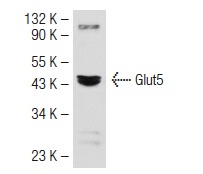
Western blot analysis of Glut5 expression in MCF7 whole cell lysate.| Product Name | Glut5 Antibody (H-200) |
|---|---|
| Antibody Type | Primary Antibodies |
| Modification Notes | Glucose is the major source of our energy and there are numerous isoforms of the glucose transporter in mammals, including Glut1, Glut2, Glut3, Glut4, Glut5, Glut6, Glut7, Glut8 and Glut9 (1). The GLUT5 gene located on the short arm of human chromosome 1 encodes a 501 amino acid facilitative glucose transporter. Glut5 mRNA is highly expressed in small intestine and to a lesser extent in kidney, skeletal muscle and adipose tissue (1-2). Glut5 plays a critical role in fructose absorption in the small intestine and its expression is highly induced when exposed to a fructose-enriched diet (3-4). Glut5 transporter expressed in human skeletal muscle is specifically localized to the plasma membrane, where it participates in regulating hexose transfer across the sarcolemma (5). Glut8, a novel glucose transporter-like protein, exhibits significant sequence similarity with the other members of sugar transporter family. Glut8 comprises 12 putative membrane-spanning helices and several conserved motifs, which are important for transport activity. In human tissues, Glut8 is predominantly expressed in testis and, to a lesser extent, in most other tissues including skeletal muscle, heart, small intestine and brain. In addition, the Glut8 glucose transport facilitator has a hormonally regulated testicular function (6). |
| Clonality | Polyclonal |
|---|---|
| Isotype | IgG |
| Host Species | Rabbit |
| Tested Applications | WBIPIFELISA |
| recommended for detection of Glut5 of mouse, rat and human origin by WB, IP, IF and ELISA | |
| Species Reactivity | HumanMouseRat |
| Concentration | 1mg/ml |
| Purification | Affinity purified |
| Alternative Names | epitope corresponding to amino acids 221-420 of Glut5 of human origin |
|---|---|
| Tissue Specificity | epitope corresponding to amino acids 221-420 of Glut5 of human origin |
| Entrez Gene | 6518 |
|---|
Application
Western blot analysis of Glut5 expression in MCF7 whole cell lysate.| Application Notes | recommended for detection of Glut5 of mouse, rat and human origin by WB, IP, IF and ELISA |
|---|
| Form | Liquid |
|---|---|
| Storage Instructions | For short-term storage, store at 4° C. For long-term storage, aliquot and store at -20ºC or below. Avoid multiple freeze-thaw cycles. |
| Storage Buffer | phosphate buffered saline , pH 7.4, 150mM NaCl, 0.02% sodium azide and 50% glycerol. |


