Application
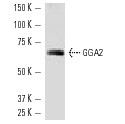
Western blot analysis of GGA2 expression in mouse lymph node tissue extract.| Product Name | GGA2 Antibody (H-175) |
|---|---|
| Antibody Type | Primary Antibodies |
| Modification Notes | A family of proteins, the GGAs (Golgi-localized, g-adaptin ear-containing, ARF-binding proteins) sequences that showed significant homology to the carboxy-terminal 'ear' domain of g-adaptin. Members of the GGA family (GGA1,GGA2 (also known as VEAR or VHS domain and ear domain of g-adaptin) and GGA3) are ubiquitous coat proteins that facilitate the trafficking of proteins between the trans-Golgi network and the lysosome. However, unlike g-adaptin, the GGAs are not associated with clathrin-coated vesicles or with any of the components of the AP-1 complex. GGA1 and GGA2 are also not associated with each other, although they colocalize on perinuclear membranes. GGA2 shares 45% amino acid sequence identity with GGA1 and 35% with GGA3. In addition to being involved in heterotypic vesicle/suborganelle interactions associated with the Golgi complex, GGA2 may have a tissue-specific function and is highly expressed in kidney, muscle and heart. Furthermore, the VHS domain of GGA2 binds to the acidic cluster-di-leucine motif in the cytoplasmic tail of the cation-independent mannose 6-phosphate receptor (CI-MPR) and this is important for lysosomal enzyme targeting. |
| Clonality | Polyclonal |
|---|---|
| Isotype | IgG |
| Host Species | Rabbit |
| Tested Applications | WBIPIFELISA |
| recommended for detection of GGA2 of mouse, rat and human origin by WB, IP, IF and ELISA | |
| Species Reactivity | HumanMouseRat |
| Concentration | 1mg/ml |
| Purification | Affinity purified |
| Alternative Names | epitope corresponding to amino acids 301-475 mapping within an internal region of GGA2 of human origin |
|---|---|
| Tissue Specificity | epitope corresponding to amino acids 301-475 mapping within an internal region of GGA2 of human origin |
| Entrez Gene | 23062 |
|---|
Application
Western blot analysis of GGA2 expression in mouse lymph node tissue extract.| Application Notes | recommended for detection of GGA2 of mouse, rat and human origin by WB, IP, IF and ELISA |
|---|
| Form | Liquid |
|---|---|
| Storage Instructions | For short-term storage, store at 4° C. For long-term storage, aliquot and store at -20ºC or below. Avoid multiple freeze-thaw cycles. |
| Storage Buffer | phosphate buffered saline , pH 7.4, 150mM NaCl, 0.02% sodium azide and 50% glycerol. |


