Application
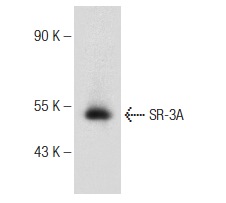
Western blot analysis of SR-3A expression in human colon tissue extract.Application
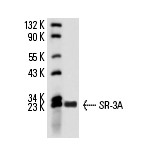
Western blot analysis of human recombinant SR-3A.| Product Name | SR-3A Antibody (H-138) |
|---|---|
| Antibody Type | Primary Antibodies |
| Modification Notes | Serotonin (also designated 5-hydroxytryptamine or 5-HT) is a molecule that functions as a neurotransmitter, a hormone and a mitogen, and it is predominantly expressed in the gut, platelets and central nervous system (CNS). In the CNS, serotonin modulates several processes, including anxiety, sleep, appetite, behavior and drug abuse. In platelets and gut, serotonin plays a major role in cardiovascular function and motility of the gastrointestinal tract, respectively. Serotonin mediates its effects through several of G protein coupled receptors, designated 5-HT receptors or alternatively SR receptors. SR-3 is a ligand-gated ion channel, whereas all other known serotonin receptor subtypes are G protein-coupled receptors. SR-4 mediates widespread effects in central and peripheral nervous systems. SR-7 belongs to the superfamily of G protein-coupled receptors. The gene which encodes SR-7 maps to human chromosome 10q21-q24. |
| Clonality | Polyclonal |
|---|---|
| Isotype | IgG |
| Host Species | Rabbit |
| Tested Applications | WBIPIFELISA |
| recommended for detection of SR-3A of mouse, rat and human origin by WB, IP, IF and ELISA | |
| Species Reactivity | HumanMouseRat |
| Concentration | 1mg/ml |
| Purification | Affinity purified |
| Alternative Names | epitope corresponding to amino acids 341-478 mapping at the C-terminus of SR-3A of human origin |
|---|---|
| Tissue Specificity | epitope corresponding to amino acids 341-478 mapping at the C-terminus of SR-3A of human origin |
| Entrez Gene | 3359 |
|---|
Application
Western blot analysis of SR-3A expression in human colon tissue extract.
Application
Western blot analysis of human recombinant SR-3A.| Application Notes | recommended for detection of SR-3A of mouse, rat and human origin by WB, IP, IF and ELISA |
|---|
| Form | Liquid |
|---|---|
| Storage Instructions | For short-term storage, store at 4° C. For long-term storage, aliquot and store at -20ºC or below. Avoid multiple freeze-thaw cycles. |
| Storage Buffer | phosphate buffered saline , pH 7.4, 150mM NaCl, 0.02% sodium azide and 50% glycerol. |


