Application
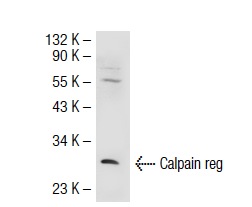
Western blot analysis of Calpain reg expression in TF-1 whole cell lysate.Application
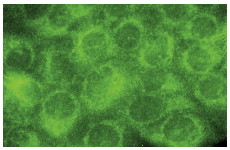
Immunofluorescence staining of methanol-fixed A-431 cells showing cytoplasmic localization.| Product Name | Calpain reg Antibody (H-60) |
|---|---|
| Antibody Type | Primary Antibodies |
| Modification Notes | Calpain 1 is an intracellular calcium-dependent protease that cleaves cyto-skeletal and submembranous proteins. Calpains are nonlysosomal, calcium-activated intracellular cysteine proteases. Calpains mediate specific Ca2+-dependent processes including cell fusion, mitosis and meiosis. Calpains are heterodimers of a small regulatory subunit, designated Calpain reg, and one of three large catalytic subunits, designated Calpain 1, Calpain 2 and Calpain p94. Calpastatin regulates Calpain by inhibiting both the proteolytic activity of Calpain and its binding to membranes. Calpastatin exists in two types, tissue type and erythrocyte type, resulting from both alternative splicing and proteolytic processing. Calpain 1 co-localizes with human leukocyte antigen-DR (HLA-DR) on activated microglia in the aging brain. Calpain influences the process of spermatogenesis and the events preceding fertilization, such as the acrosome reaction. |
| Clonality | Polyclonal |
|---|---|
| Isotype | IgG |
| Host Species | Rabbit |
| Tested Applications | WBIPIFELISA |
| recommended for detection of Calpain regulatory subunit of mouse, rat and human origin by WB, IP, IF and ELISA also reactive with additional species, including equine, canine, bovine and porcine | |
| Species Reactivity | HumanMouseRat |
| Concentration | 1mg/ml |
| Purification | Affinity purified |
| Alternative Names | epitope corresponding to amino acids 171-230 mapping near the C-terminus of Calpain reg of human origin |
|---|---|
| Tissue Specificity | epitope corresponding to amino acids 171-230 mapping near the C-terminus of Calpain reg of human origin |
| Entrez Gene | 826 |
|---|
Application
Western blot analysis of Calpain reg expression in TF-1 whole cell lysate.
Application
Immunofluorescence staining of methanol-fixed A-431 cells showing cytoplasmic localization.| Application Notes | recommended for detection of Calpain regulatory subunit of mouse, rat and human origin by WB, IP, IF and ELISA also reactive with additional species, including equine, canine, bovine and porcine |
|---|
| Form | Liquid |
|---|---|
| Storage Instructions | For short-term storage, store at 4° C. For long-term storage, aliquot and store at -20ºC or below. Avoid multiple freeze-thaw cycles. |
| Storage Buffer | phosphate buffered saline , pH 7.4, 150mM NaCl, 0.02% sodium azide and 50% glycerol. |


