Application
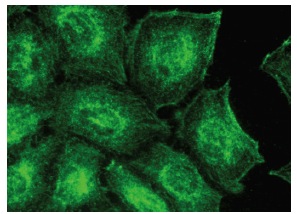
Immunofluorescence staining of methanol-fixed HeLa cells showing cell surface localization.Application
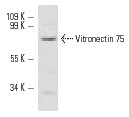
Western blot analysis of Vitronectin 75 expression in Hep G2 whole cell lysate.| Product Name | Vitronectin 10/65/75 Antibody (H-202) |
|---|---|
| Antibody Type | Primary Antibodies |
| Modification Notes | Fibronectin and Vitronectin are extracellular matrix glycoproteins that are present on most cell surfaces, in extracellular fluids, and in plasma. Both Fibronectin and Vitronectin have been shown to be involved in various functions including cell adhesion, cell motility and wound healing. Vitronectin contains an RGD (Arg-Gly-Asp acid) sequence that is present in many cell adhesion ligands. The RGD sequence has been shown to be essential for cell adhesion. Increased expression of Vitronectin, integrins and plasminogen activators has been observed in migrating cells during wound healing. Vitronectin has been shown to enhance smooth cell migration, and PAI-1 has been shown to bind to Vitronectin with high affinity, resulting in the blocking of smooth cell migration. Glycosaminoglycans, proteins involved in the anchoring of vitronectin to the extracellular matrix, have been shown to stimulate the cleavage of vitronectin by plasmin. This cleavage reduces the affinity of vitronectin for PAI-1. |
| Clonality | Polyclonal |
|---|---|
| Isotype | IgG |
| Host Species | Rabbit |
| Tested Applications | WBIPIFELISA |
| recommended for detection of Vitronectin 10, 65 and 75 of mouse, rat and human origin by WB, IP, IF and ELISA | |
| Species Reactivity | HumanMouseRat |
| Concentration | 1mg/ml |
| Purification | Affinity purified |
| Alternative Names | epitope corresponding to amino acids 277-478 mapping at the C-terminus of Vitronectin 75 of human origin |
|---|---|
| Tissue Specificity | epitope corresponding to amino acids 277-478 mapping at the C-terminus of Vitronectin 75 of human origin |
| Entrez Gene | 7448 |
|---|
Application
Immunofluorescence staining of methanol-fixed HeLa cells showing cell surface localization.
Application
Western blot analysis of Vitronectin 75 expression in Hep G2 whole cell lysate.| Application Notes | recommended for detection of Vitronectin 10, 65 and 75 of mouse, rat and human origin by WB, IP, IF and ELISA |
|---|
| Form | Liquid |
|---|---|
| Storage Instructions | For short-term storage, store at 4° C. For long-term storage, aliquot and store at -20ºC or below. Avoid multiple freeze-thaw cycles. |
| Storage Buffer | phosphate buffered saline , pH 7.4, 150mM NaCl, 0.02% sodium azide and 50% glycerol. |


